As I wrote, I channeled my mother and grandmother raising me, as well as what I brought into my own children’s childhoods.
In Chapters One thru Five, we met Sarah Rushton walking her land grant in 1827 Westchester, Nova Scotia with her daughter Elizabeth and grandchildren. Sarah, husband Jeremiah, and family were exiled from New York as Loyalists after the Revolution. Promised land, the family boarded a ship for the unknown. After years, they boated and walked for days, hauling their belongings: iron pots, bedding, cows. Fretting over her husband’s plans to move the family to Upper Canada, Elizabeth asked, “How will I have a baby by myself in the wilderness?” Sarah explained that she avoided pregnancy as a refugee due to the danger. Considering childbirth’s risks without a midwife, kin, or house, Elizabeth decided to send her husband on and join him later.
The Story of the Farmer’s Wife….a fictional look
“I’m hungry!” The first child reappeared.
“Can we go back now?” William agreed with his brother.
“Eat!” Lucy yelled.
“All right,” Sarah acquiesced, “we’ll head back.”
Turning in the direction of the house, she pointed. “Then we started making our very own home. We just had the chests to sit on, and we used the barrels for a table. Papa said he’d make furniture come winter. Half the house was the kitchen, and the other half we called the keeping room,1 even tho our bed was in it,” Sarah laughed. “We didn’t put Abraham in the loft until we were sure he wouldn’t fall off, so we just used it for storage. Papa built the floor the next year, I think.
“First off, we broadcast the buckwheat seed among the stumps so we could harvest it that fall. Of course Papa chopped wood every day, hoping to have enough to last the winter. Then we started the vegetable garden that we could harvest that fall too.
“Do you know what?” Sarah leaned over to kiss Lucy on the nose.
“What?” Lucy screwed up her face and rubbed her nose.
“Our root cellar was just a hole in the shade of a big tree!”
“Grannie!” William laughed. “It’s so big now!”
“Big as a house,” Eddie agreed.
“We were busy, but kind of lonely after all of us being together at Fanningborough. So every Saturday, we went to your grannie and grampa’s house for the day.”
“So that’s how our Saturday visits started,” Elizabeth remarked.
“Yes, and we usually spent the night, so we’d be there for prayer service next day.2
“It being just Grampa and Samuel, they needed help clearing. We were all worried that we’d lose our land if we didn’t do what we needed to by the first three years. We all had houses built, but we didn’t have enough land cleared. Your papa and I only had about twelve acres cleared,3 and we needed thirty. It was all right, tho, as long as we were living there and had something planted.
“We women baked at Grannie’s all day, or whatever else needed doing.”
She laughed. “You should have seen us the first year we tried to make soap! Only your grannie remembered how to do it, and Aunt Catherine said she knew how. I just remembered how my mother made it. Aunt Catherine told us all to collect the wood ashes all year long, from any kind of fire we had, and put them in a barrel. Grannie had a hopper made special. Then we argued over where we were going to make the soap, at whose house. I said we should make it here, as our grant is in the middle. But Aunt Catherine wanted her place, and Grannie said she wasn’t going all that way carrying lye and pots. Finally we agreed to go to Aunt Catherine’s just to quieten her, and Uncle Peter and their sons said they would carry all the lye and kettles down there.
“It only made sense to mix the lye all together to carry it. But was Aunt Catherine mad when we got there and it was all mixed! Wanted to keep hers separate, she said, because hers was done right. Mine was too strong, or too weak, I don’t remember which, and Grannie’s was the opposite.
“My mother always floated an egg on top to see if it was ready, and so did Aunt Catherine, but Grannie said it had to be a potato, so we did both. Either way, it wasn’t right, so we had to start all over again. We made three batches before we got soap!
“In the end, they said, it was due to all the arguing. After that, when it came soap-making time, we were all so polite it was funny! It was all, ‘if you please,’ and ‘do you mind if,’ and, ‘this is the finest-tasting something-or-other I have ever eaten!’”
“Then you probably tried to outdo each other on the compliments!” Elizabeth laughed. “That must have been fun.”
“It was. I even got the children to call everyone ‘my Lord’ and ‘my Lady!’ We fell to giggling every time they said it!
“Anyway, next year, we all made our own at our own homes, just went to each other’s houses to help. It didn’t turn out much better. Aunt Catherine said it was the fault of the Nova Scotia trees, the ash is different here than it is in New York!”
Elizabeth burst out laughing.
“I ran out of soap pretty quickly, and we had to make an extra trip to the shore to buy some. Your papa had shoes to trade, tho, and we bought some yarn, so I could knit us sweaters, and then I was happy.” She smiled at the memory.
“If the soap was that bad, Mama, how did the candles go?” Elizabeth asked.
“Some better. Candles are not as complicated, but much more tedious. We had to make up songs, just to keep from losing our minds.
“‘Here we go dip dip dipping! There we go drop drop dropping!’”
“I remember that!” Elizabeth began to sing, “Where we go wick wick wicking! And never stop stop stopping!”
William and Eddie repeated the lines. The women corrected mistakes and filled in the blanks until everyone was laughing.
“Dop dop dop!” Lucy chanted.
“And that’s when we learned to count to a hundred!” Elizabeth cried.
“I can do that,” boasted William and immediately started in. Eddie followed. “No! You’re doing it wrong!”
The group stopped walking, but the mathematical proof argument continued apace. “You’re too loud. Go on over there,” Elizabeth told them, pointing down the path. The women sat on a wooden bench by the house. Lucy climbed into Sarah’s lap.
“So much work,” Sarah shuddered. “I would look at the sputtering smelly candles and think, how many weeks before I have to make them again?”
“Anyway! On to better smells!” Sarah kissed the top of Lucy’s head. “I baked at home nearly every day, in a little bake kettle in the coals. It wasn’t till much later your papa built me a real bake oven. So almost everything we ate was boiled in the big kettle4…turnips, potatoes, carrots, and rabbit, partridge, and fish too, if your papa got some.”
The boys returned.
“Your really big pot that goes up and down!” Eddie exclaimed.
“And in and out,” William added.
“Why does it do that, Grannie?” Eddie asked.
“If the food is cooking too fast, I bring the pot out. If it needs to boil more, I lower it.”
“So if it boils too much, you raise it?” William checked.
“That’s right.”5
Elizabeth stopped and stretched, putting her hands on her back. “What was the hardest thing to get used to?” she sighed. “That was different from your life before?”
“The hardest thing was making cloth after being used to buying it in a city. I wasn’t in a fast hurry to plant that flax, I tell you. Thank Goodness the grant didn’t say how much flax we had to plant, so we only sowed a little. We wore our clothes till they were almost rags, tho I washed them as gentle as I could. We went to the shore to buy things once a year, and I always wanted to buy cloth, but…It was very high priced,6 and we had to spend our money on other things. Grampa had his cordwaining tools, so we made shoes.
“I always tried to trade them for cloth,” Sarah chuckled, “but we had to go with whatever we needed. I got to where I could spin and weave, but I was never very good at it.”
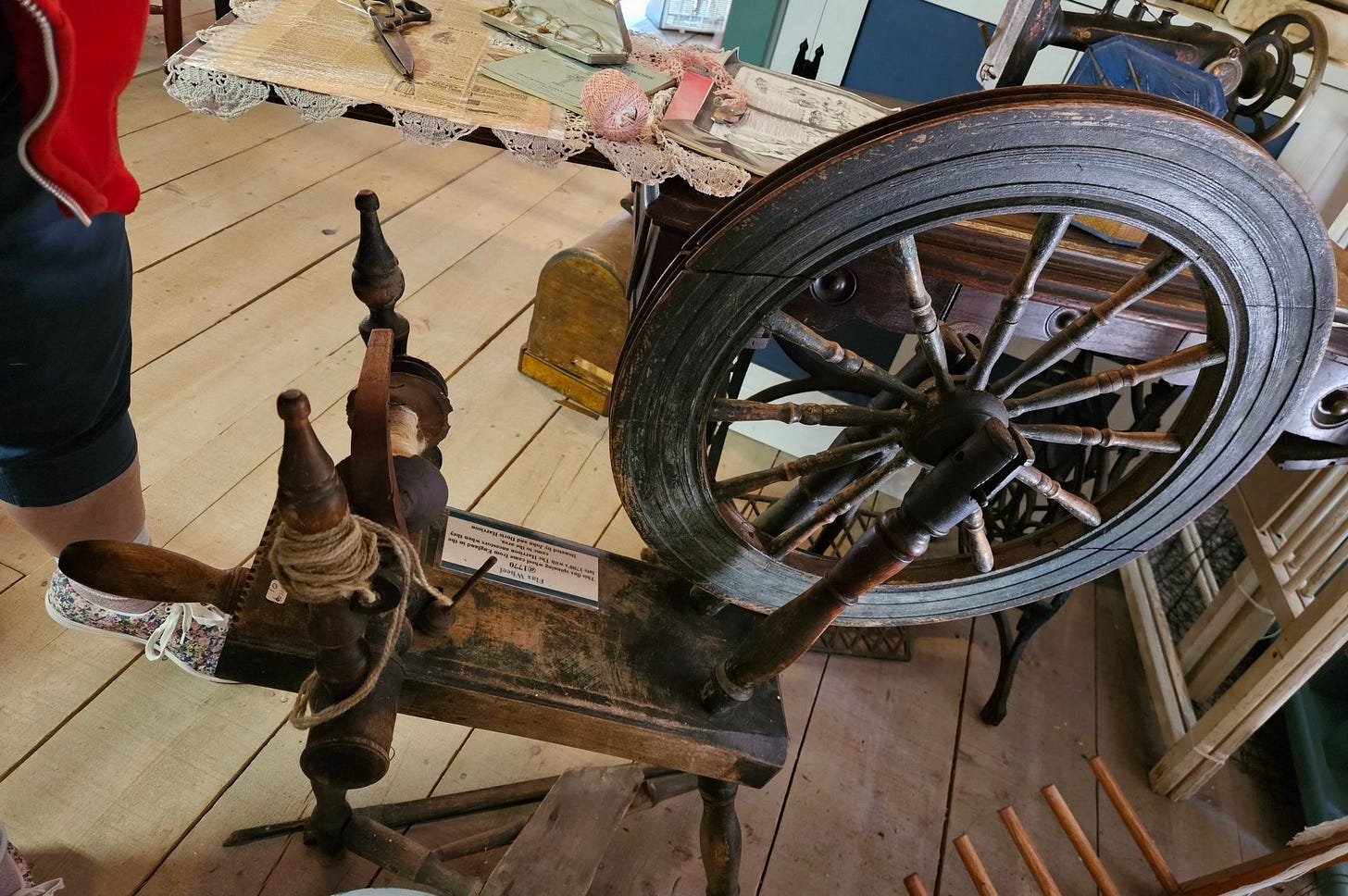
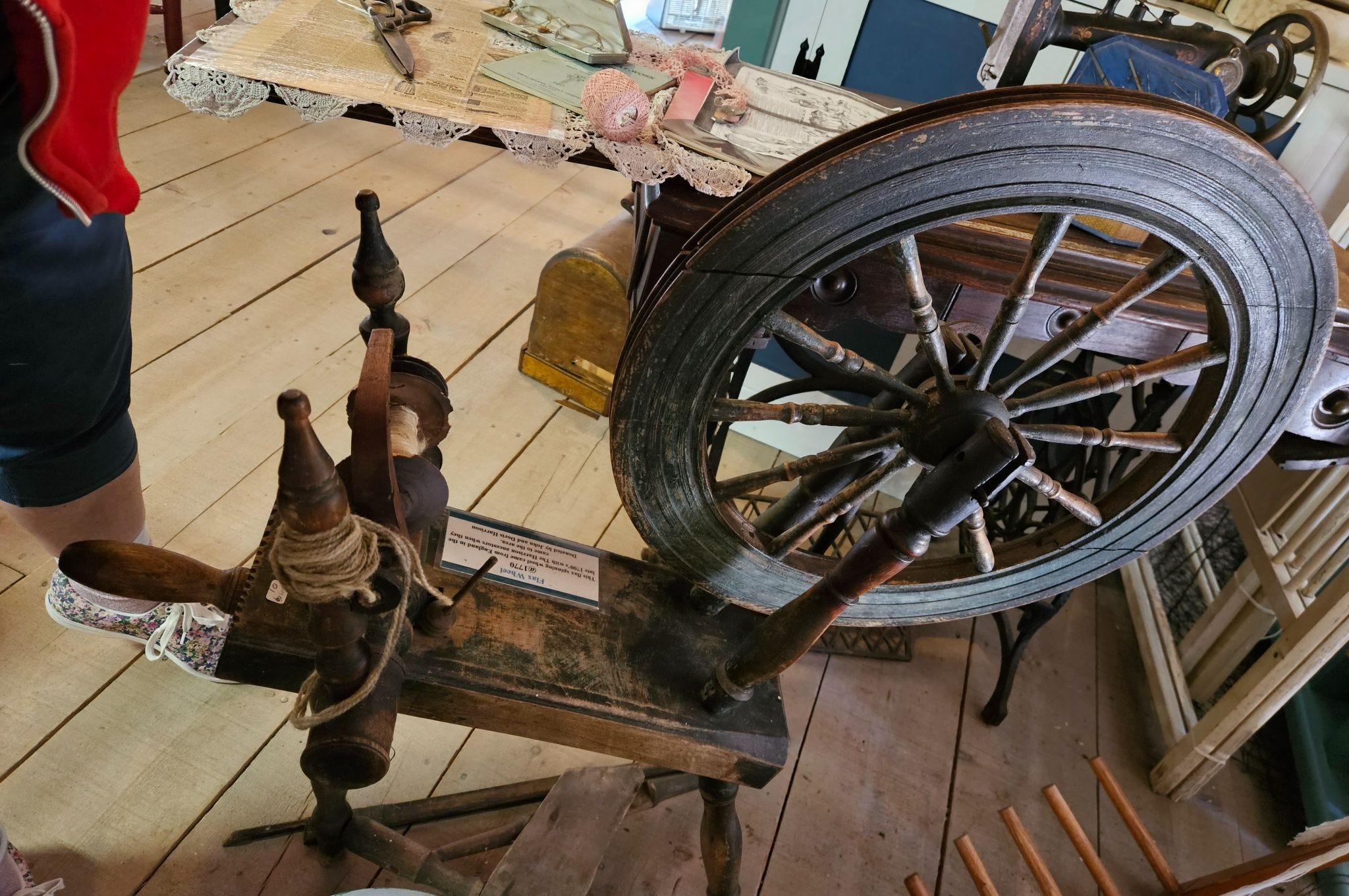
The flax spinning wheel of my other ancestor named Sarah, my 5th great-grandmother Sarah Lovell Harrison. The two Sarahs were contemporaries in Nova Scotia and related by the marriage of Sarah Rushton’s son Isaac to Sarah Harrison’s granddaughter Ester. Age of Sail Museum, Parrsboro, Nova Scotia, photo by author 2022
“You’re good at knitting, Grannie,” William observed.
“Thank you, grandson,” Sarah smiled at him. “I love knitting.”
“Have you ever watched Grannie knit?” Elizabeth asked the children. “Do you know what she can do?”
“What?”
“Knit with her eyes closed!”7
“Really?” “You can?” “ I want to see!” came the chorus of amazed responses.
“I’ll show you next time,” Sarah promised.
“I liked those first years…they were very simple. What we needed to do next was right in front of us. Browny needed oats, so we planted oats. Browny needed shelter, so we built her a lean-to, right against the house, so I didn’t have to go far to milk her. We saw a moose, so we all got together and hunted it. Meat lasted all winter.”
“You saw a moose, Grannie?” Eddie looked around him with awe. “Right here?”
“No, silly,” William scolded, but Sarah pointed to the brook. “Right there. Back then they were all over. You had to be real careful when you went outside. I think they came by to see who we were, taking over their home.8
“Every year, we added something new. A new baby. More land cleared. Planted flax and hemp. We bought two sheep, so we sheared them. I knitted us all mittens and hats!”
We built Browny a bigger barn. A real root cellar. Made the lean-to bigger when the boys got old enough to sleep there. Added a summer kitchen on the side.”
“Did you build an outhouse, Grannie?”
“Yes, that too, so I didn’t have to go carrying all that slop.”
“Ooooh,” Eddie made a face. William pantomimed dumping slop on his head, and the boys ran off yelling. Lucy squirmed to get down and followed.
“Boys!” Elizabeth shook her head, chuckling.
“At least you have more girls! We had so many boys, we lent them out to work on their uncles’ land. We traded for nieces to come in and help. Not until you girls were old enough to learn and there weren’t so many babies to care for, did we get a spinning wheel for the flax, and a small loom.”
“A man may work from sun to sun, but women’s work is never done,” quoted Elizabeth.9
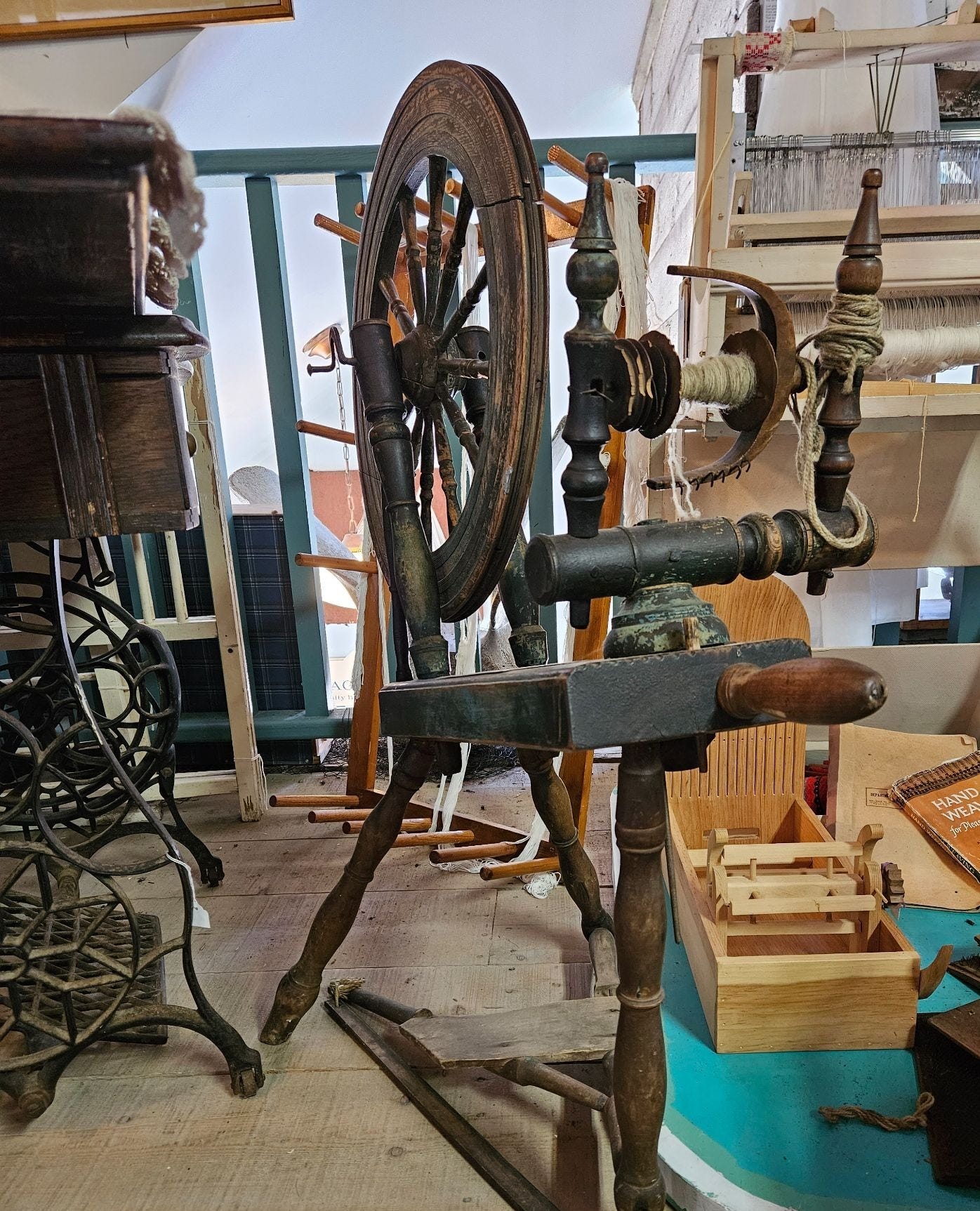
Sarah Harrison’s flax spinning wheel, designed to use while sitting, Age of Sail Museum, Parrsboro, NS, photo by author, 2022
A Chronicle of a Farmer’s Wife…a factual account
Responsibilities of the Land Grant
The Cobequid and Ramsheg grants came with responsibilities. Britain wanted to make sure its colony was developed and peopled with loyal industrious subjects, and it wanted to make sure it received income from its investment. Each grantee had to pay a quit-rent of 2 shillings per 100 acres. Quit-rents were essentially taxes – the name comes from the idea that the payer did not have to perform feudal obligations or rent to a lord.10 Jeremiah and Sarah owed 10 shillings each year at the Feast of St. Michael, September 29. A grace period before they had to start paying was printed in the grant document, but the date was left blank. Possibly it was the same three years that grantees had to fulfill the other conditions.
The Crown wanted Nova Scotia settled, and that meant cultivated. Three acres needed to be cleared and worked for every 50 granted, so the Rushtons needed to cultivate 30 acres in those three years. If the land was marshy, they needed to drain 30 acres of it in that time instead. If the land was too barren, grantees had to keep 30 head of cattle until they could meet the cultivation requirements. If the land was too rocky even for that, the requirement could be met by hiring workers to quarry or mine it, one able worker per 50 acres for the three years.
by Currier and Ives11

Regardless, a dwelling house of not less than 16 by 20 feet was necessary within the three years, as the Crown wanted to be certain the land was occupied.
The grant itself had to be registered in the Province’s Registry Office within six months of issuance, and the grantee had to take the oath of allegiance to King and Parliament. Any future owner was required to do so within twelve months.
In the 1791 census, taken the year after the grant’s requirements came due, Sarah and Jeremiah had four children under age. However, we know from genealogies that three of them were also under 5, and Abraham was only 9. With a family this young, it is almost certain that they relied upon their extended family to help them do the work necessary to meet the conditions.
Rights of the Land Grant
The grant promised settlers quite a few rights on their land. They had the privilege of hunting, hawking, and fowling, which was meaningful because England had historically restricted those rights to the upper classes. They could also fish and use any lakes or ponds on their land, as well as waters and water courses on or adjacent. They held rights to all woods, underwoods, timber, and timber trees. Rights to mines and minerals on their land were included. Profits and the right to sell commodities belonged to the grantee also.
The Crown reserved specifically to itself valuable minerals…gold, silver, copper, lead, and coal. Most important was the Crown right to white pine trees, which it needed for masts for the mighty British naval ships.12
The new grantees could sell, gift, or bequeath their land, and the rights and responsibilities would transfer to the new owners.
The grant could revert to the Crown if the quit-rent wasn’t paid, the grant wasn’t registered within six months, or the owner failed to take the oath of allegiance.13
The First Three Years
The land immediately after clearing would have been ashes of burned ground riddled with stumps. Therefore the very first crops Jeremiah and Sarah grew needed to be able to grow in that soil without having to plow it. Buckwheat was the most common crop for many years. It thrives in acidic, recently burned soil and can be broadcast by hand among the stumps. It can germinate and mature in as little as ten weeks and it suppresses weeds, incredibly important in a field just cleared of woods.
a field of buckwheat14

Sarah could cook buckwheat without needing to mill it; she could crack it with just a mortar and pestle, cook it whole as a porridge, or grind it coarsely and then bake it into bread or pancakes. According to the University of New Brunswick, buckwheat was among the most important crops in Nova Scotia, “where farmers responded to limited resources by planting less-demanding crops.”15
Potatoes were almost certainly the next crop Sarah and Jeremiah grew. They also don’t need plowing, just the placing of a seed potato in a hole, and they also love poor soil. Potatoes provide the most calories per square inch of ground and store well all winter.16
carrots and parsnips17
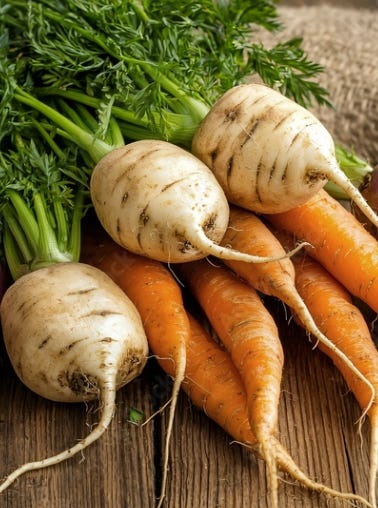
Gardens were women’s work. Sarah would have started her garden as soon as possible with winter-friendly vegetables: turnips, cabbages, beans, carrots, parsnips, and onions. Turnips grew fast and tolerated frost, providing greens as well as starch. Cabbage could be fermented into semi-sauerkraut to last.18 Parsnips, which actually become sweeter after frost, could be kept in the ground and dug up all winter.
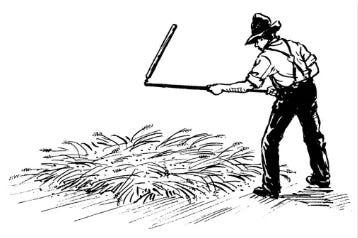
Once they cleared more ground, Jeremiah and Sarah could plant oats and rye. Oats were especially reliable, did well in acidic soil, and could be used for both people and animals. Jeremiah could harvest them by hand with scythe and sickle, then thresh the oats with a flail.19
threshing with a flail20
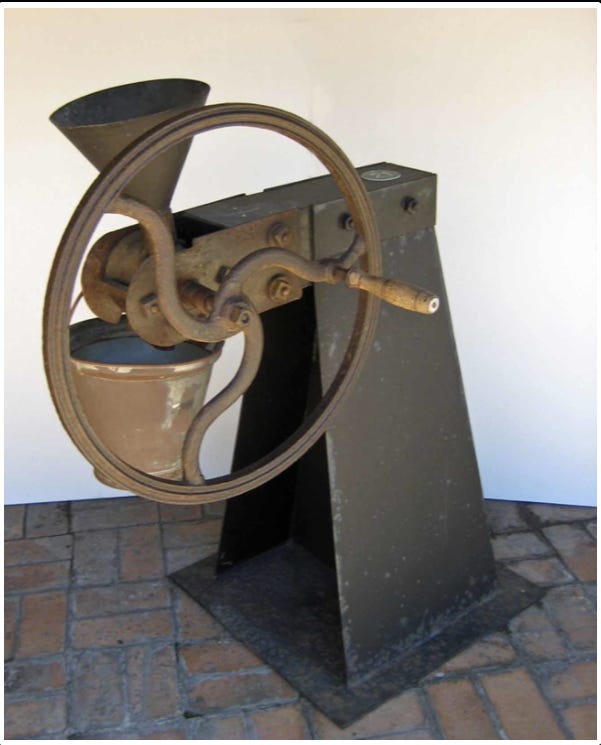
Rye, also tolerant of poor soil, was made into bread. Wheat would have been a later addition as it needed a mill to grind it into flour. In 1799, John Rushton left his son Samuel his steel gristmill.21 Altho we don’t know its size, it had steel grinding plates rather than millstones. It may have been hand-operated or driven by an animal or two.
hand powered grist mill22
Some hay grew where stumps had been pulled,23 but it required more land to grow in quantity. The Refugees from New York may have expected to grow corn, but it would not have prospered in the shorter growing season.
The growth of hemp and flax were required by the terms of the land grant, but would not have been able to be started for years. Flax was the fiber used to make linen. Altho highly labor intensive, flax is an incredibly useful crop. It has the highest tensile strength of any natural fiber, meaning it can be stretched the furthest without breaking. It’s highly absorbent and dries quickly, but is twenty percent stronger when wet. Amazingly long-lasting, a linen sheet is still viable after a century of regular use.
Women and children were the ones who turned a flax plant into clothing in a long laborious process that took over a year. Because of the time delay in which this year’s crop became next year’s shirt, families on the Cobequid grant could not expect a steady supply of new clothes until they had been there for several years.
It would be some time before a Westchester farmer could plant flax. They would need a plow, a draft animal, and level cleared land. The ground needed to be prepared well: plowed and tilled several times over six months. It’s possible that Sarah and Jeremiah delayed planting flax and hemp as required until the last possible moment, as they had infant children rather than working teenagers.
farmers in Ireland plowing a field and broadcasting flax seeds,179124
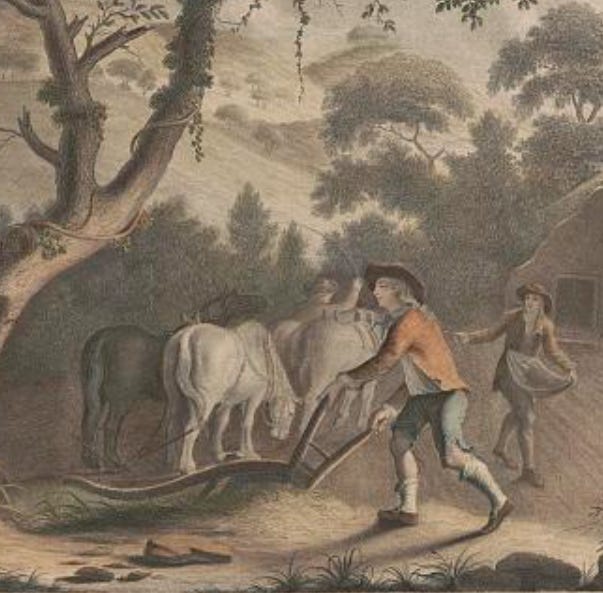
The seeds were broadcast in mid-spring to be ready for harvest in August. Closely-spaced seeds caused tall thin high-quality flax with no need for weeding.
a field of flax25
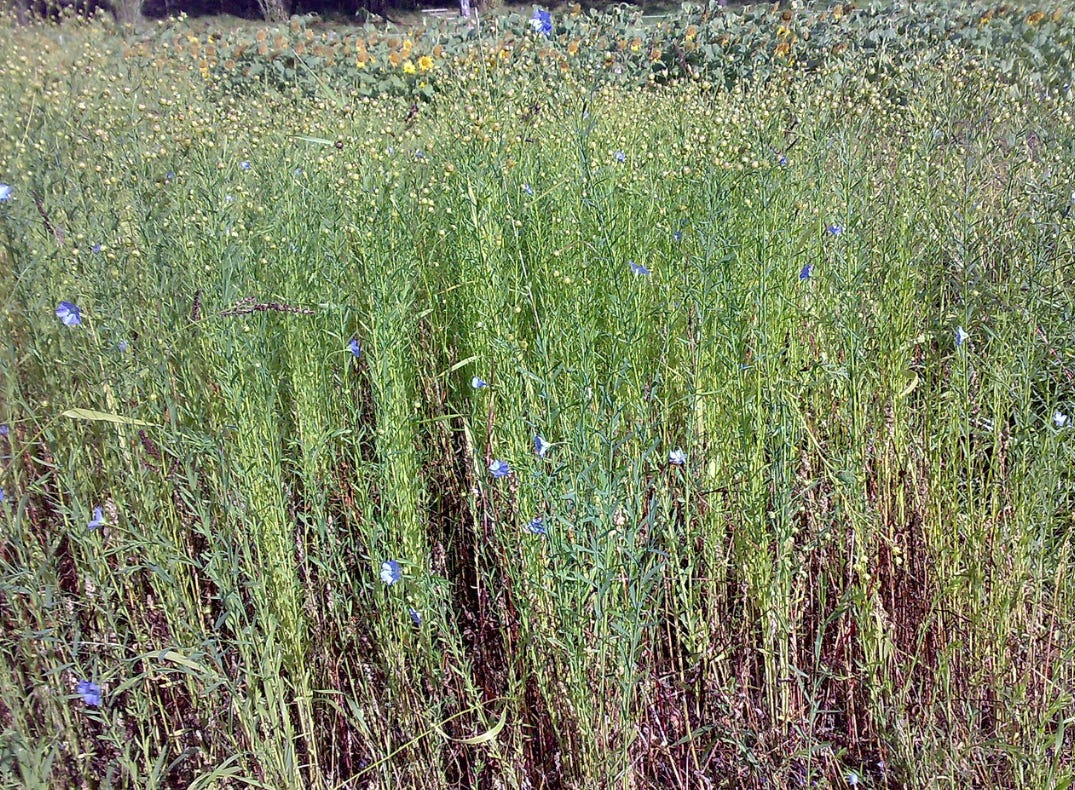
When the leaves yellowed and the seeds turned brown, the flax would be hand-pulled from the ground by the roots and spread to dry. In rippling, bundles of flax were drawn through the teeth of a comb to remove the seed-heads from the stalks. Seed-heads could be used to feed cattle and seeds could be pressed into linseed oil.
The most important step, retting (rotting) involved rotting away the unwanted woody core of the stalk. The best way to ret flax was to run it under the cold water of a stream, and Sarah had multiple streams on her land to choose from. What would have been difficult was knowing the exact time to remove and dry it, depending on the temperature and the flax itself, among other things. This was a judgment call honed thru years of practice, but Sarah, coming from a city, would have needed help from an experienced settler.
A farmer in Ireland removing flax after it has been retted, while people in the background spread it out to dry, 179126
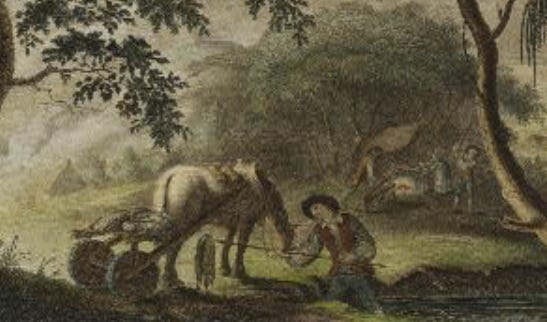
After that, the bundles were separated, spread out to dry thoroughly on each side, and stored for a few weeks.
Sarah still needed to separate the linen fiber from the rest of the plant. A large wooden break loosened the unwanted fiber further.
flax after breaking27
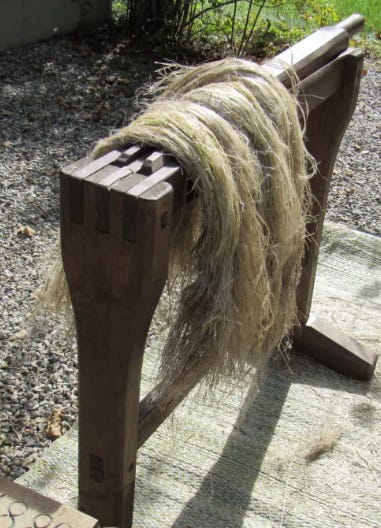
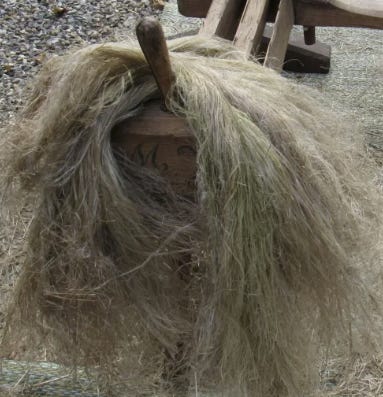
Then she beat the flax against a board, called scutching.
Flax after scutching28
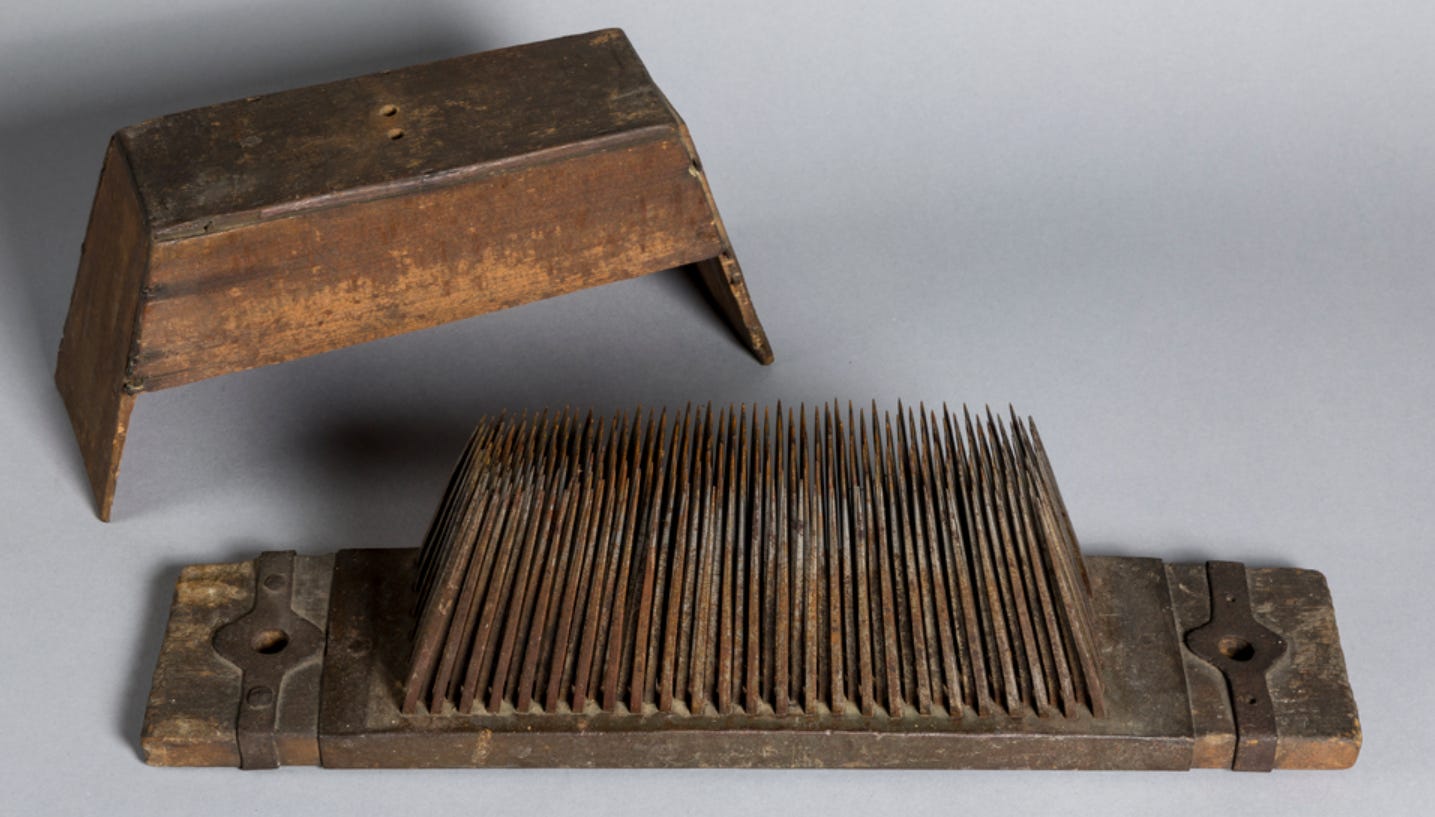
Lastly, Sarah hackled the fiber, drawing it through a board with iron spikes. After hackling, both strick and tow resulted. Strick is a long smooth gray line of flax, like hair; tow is short and tangled. The line of flax would become linen, while the tow would become coarse cloth.
a flax hackle ca.180029
The line of flax was then spun by Sarah’s hands on the flax wheel, using a distaff to keep the fibers separated. She made this into linen thread, which was later woven on a loom. If she wanted, she could boil the linen yarn to bleach it before weaving.30
Rippling, breaking, scutching, and hackling would have all been done in the kitchen end of the cabin by the light of the fire in fall and winter. It was dusty scratchy hard work. Flax dust irritated eyes and lungs and the hackle’s iron spikes threatened injuries.
Between all the babies and her inexperience with flax production, I imagine Sarah would have waited for years before attempting it. Luckily the conditions of the land grant didn’t specify how much flax and hemp had to be grown. A 10-foot by 10-foot square could produce enough fabric to make one shirt. It is likely the Rushton women worked together, each woman contributing what she best could, to clothe their families.31
a family in Ireland beating, scutching, and hackling flax, 179132

an Irish family spinning, reeling on a clock reel, and boiling yarn, 179133

Hemp, the other necessity to keep the grant, was used to make rope, essential on a farm. The British required its growth to supply its navy with rope and sails. Helpfully, hemp could grow in poorer soil than flax. At six to twelve feet tall, double the height of flax, it yielded twice as much per acre. Altho it grew faster than flax, it still needed the same number of plowings and tillings.
AI-created image of a field of hemp; workers gathering, rippling, and weaving it; finished rope product; ship needing hemp rope and sails34
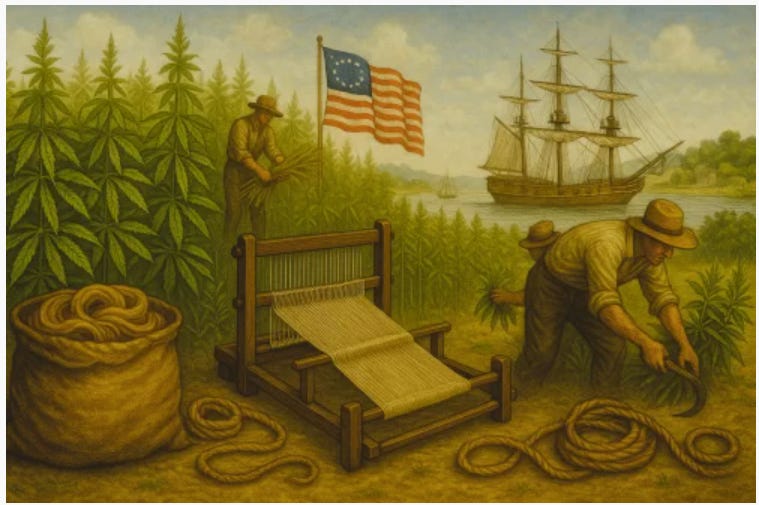
Cobequid farmers probably retted the coarse hemp by leaving it out in the cold and wet for two or three months. This was needed to weaken the resin that stuck the outer fiber to the inner stalk. Then the same breaking, scutching, and hackling were done as for flax, except that the work was physically harder and required sturdier tools, since the stalks were much thicker and woodier.35 The end product was then twisted into rope or could be spun into yarn to make canvas.36
Constructing clothing from sheep’s wool was another long laborious process, but Sarah and Jeremiah likely produced more of it than flax because the Nova Scotian winters demanded heavy coats, mittens, socks, sweaters, and blankets.
Jeremiah would have sheared sheep in early summer with hand shears with the goal of removing the wool in one piece. The desired wool was chosen and washed. Because sheep’s wool was dirty from the outdoors and greasy with lanolin, Sarah would have needed to soak it in boiling soapy water and rinse it three or four times to make it come clean. Next, the wool was picked. Children as young as 3 or 4 could pull apart the fibers to remove straw, twigs, or bugs.
woman carding wool37
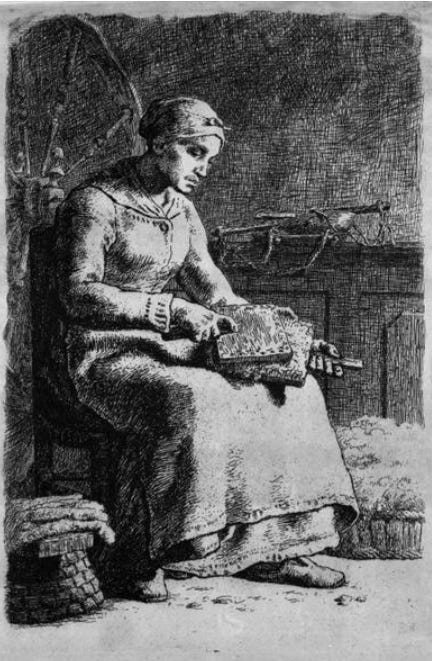
Carding was the next step. Cards were wooden paddles, hand-held, with leather on one side and bent metal pieces on the other. A small clump of fleece was placed onto one card. Sarah would have dragged the second card across the first one to untangle, straighten, and align the wool in one direction. She then would have rolled the combed wool off the teeth as a small, fluffy tube called a rolag.
Cobequid women could spin yarn by hand with a drop spindle, which was small and portable, or sit or stand at a spinning wheel, depending on the size of the wheel. Either one twisted the wool fibers into a single strand of yarn, but the large wheel was faster. Since Jeremiah’s grandfather left the younger man’s sister a small wheel in his will, someone in the Rushton family brought it to Westchester.38
A Yorkshire family carding, washing, and spinning wool, 181439
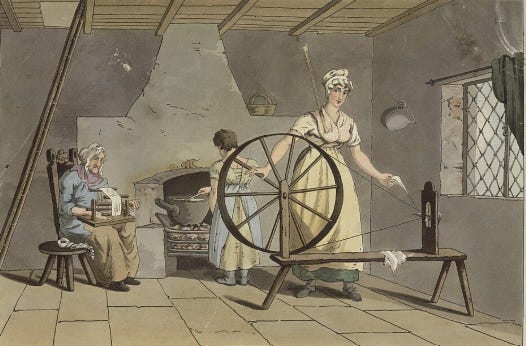
If Sarah wanted, she could have dyed her yarn. Onion skin created yellow and walnut hulls made brown. Last was knitting, which girls were taught early on, or weaving, which was much more complicated. The loom had to be set up to weave the pattern. The warp, yarn attached to the loom, had to be measured exactly and threaded onto the loom in the correct order. Then the weft threads were woven through the warp using a stick called a shuttle.40
Spinning, weaving, and knitting or sewing into garments, all highly skilled endeavors with long learning curves, came last. All the steps were needed for families to have clothes and bedding. It would be years before the Refugees were self-sufficient in creating clothing for themselves.
Later Years
To clean the clothes they made, along with their families’ bodies and everything else, women also had to make their own soap. Sarah probably didn’t have the ability at first to make soap or candles. However, once she had the tools, those chores would have been a yearly effort.
Soap is naturally formed as a chemical reaction between a base and an acid. As bizarre as it sounds, when a base, ashes of burned wood, meets a fatty acid, animal fat from a cow (tallow) or a pig (lard), soap naturally results.
Fall was usually soap-making time because butchering, which provided the animal fat, was done then for the meat to store all winter. Sarah would have saved ashes from wood fires all year. An alternative was to make soap in the spring with cooking grease that had been saved all year. Either way, the process was similar.
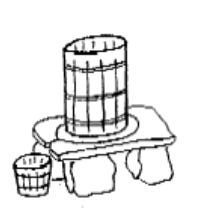
First, a liquid called lye was made from the wood ashes. The ashes were placed in a barrel or hopper in layers separated by straw. Water was slowly poured over to liquefy the ashes; the straw kept big chunks of ash from getting in the liquid. The liquid seeped out an opening in the bottom of the barrel into a container.
A barrel version and a hopper version of ashes being liquefied into lye41
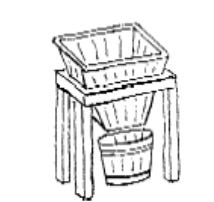
soapmaking over an open fire
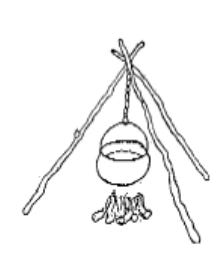
Next came the foul part. The animal fat had to be cleaned, a process called rendering, which smelled so bad it had to be done outdoors. Sarah would have boiled equal amounts of fat and water in a large pot over an open fire until the fat was all melted. The bits of meat or other impurities still in the fat sank to the bottom. Then she would have doused the fire, and added the same amount of water to cool and harden the fat again. Overnight, the clean hard fat rose to the top, much as we see fat rise to the top of stews and solidify when we refrigerate them today.
In another large pot, Sarah would have boiled the fat and lye solution together until they made soap. This was the tricky part. The ratio of fat to lye, plus the strength of the lye, were judgment calls. The lye was often determined to be the right strength if it could float an egg or a potato so that a spot the size of a ninepence (a dime) showed atop the liquid. To strengthen the lye, it could be boiled longer or run thru the ashes again; to weaken it, water was added.
The mixture had to be stirred together constantly until the thick froth appeared. That was the soap. This was done until the “bite” was right. Sarah would have put a bit of soap on her tongue. If the bite was mild or there was no bite, the soap was ready. This took six to eight hours.
Because of the uncertainty, there were many superstitions and talk of luck associated with making soap. I don’t know which ones Sarah believed in. Some said the mixture should only be stirred in one direction; others referred to the phases of the moon. Wishing your soapmaking neighbor good luck was key; I feel sure Sarah did that.42
What else would Sarah have made just once a year and hoped to last? Candles. They provided the only source of light on the Cobequid Grant after sunset, aside from the fireplace. Even during the day, the few glass windows and tall trees allowed little light to enter, and no moonlight reached the house at night either. What happened in the dark when the baby woke up, or the children needed the chamber pot?
Wintertime was worse. The sun set about 4:30 in the afternoon and didn’t rise until 7:30 or 8:00 the next morning. Snow would have reflected some light, but the shutters were probably closed against the cold and wind.
Summer was better: sunrise around 4:30 in the morning, sunset near 8:00 pm; the farmers were likely ready for sleep then anyway. By this time, it was almost candle-making season again; hopefully with all that daylight, the few candles they had left would make it thru summer.
Since candlemaking, like soapmaking, was usually done only once a year, 365 candles had to be made just to have one to use each day. Only one candle a day, for the entire cabin! All 300-plus candles needed to be stored securely in a chest, somewhere cool so they would not melt, but safe against being eaten by mice.
Mice found candles delicious: they were made of tallow, which is cow fat. Humans, however, found candles odious: tallow smelled bad as it burned. The wicks were even worse. Made of coarsely spun flax or tow, wicks sputtered and smoked.
hand-made tallow candles43
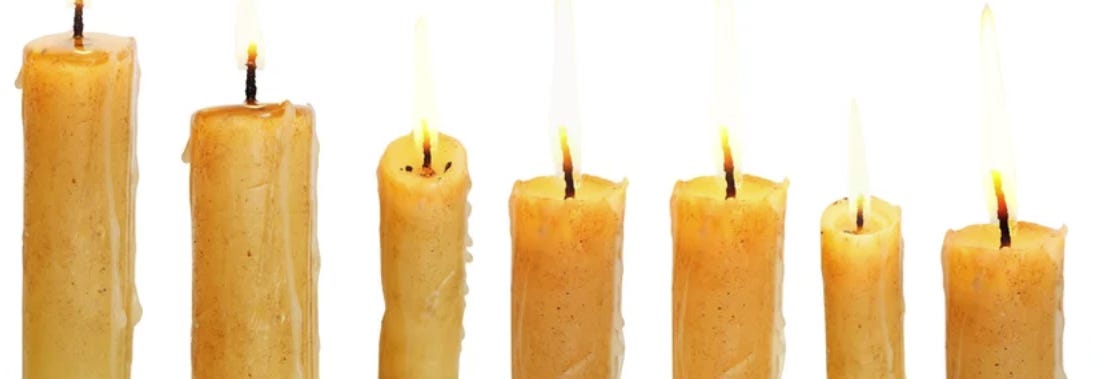
Even so, making candles was a lot of work. Just like soapmaking, Sarah would have first rendered the tallow by boiling the fat in a large kettle, allowing the meat bits and impurities to sink to the bottom, pouring cool water in to harden the fat, and letting it float to the top overnight. Then she would have ladled the clean tallow into a separate kettle.
The next step was dipping. Long wicks were draped over a stick an inch or two apart. The stick was laid across the kettle in such a way that the wicks were submerged. Tallow adhered to the wicks. Then that stick was removed to let those wicks-with-tallow-attached (we can’t call them candles yet) hang and dry. Another stick with wicks got its turn next.
Once the hanging wicks-with-tallow-attached were cool enough, they could be put back in the kettle to add more tallow, without melting what was on there already. It doesn’t sound that tedious until you find out that the wicks needed to be dipped 100 to 200 times to produce a good-sized candle! Not only that, but where would you hang 365 candles so they wouldn’t stick to each other while you were working?
1754 engraving44
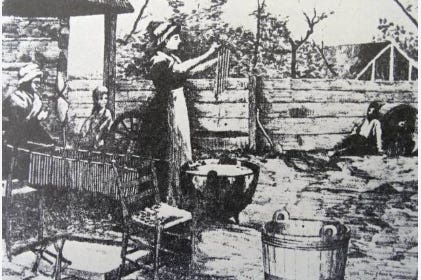
Sarah probably used racks, possibly putting them in a shed, or extended the process over a couple of days.
Given the equipment needed and the amount of animal fat necessary (they had to have animals to butcher) to make soap and candles, it’s likely that Sarah bought these items the first few years. Candles on the Cobequid grant sold for one shilling two pence per pound of candles, which was about eight of them. If approximately 46 pounds of candles were needed for the year, that multiplies out to 2 pounds 13 shillings 8 pence. A year’s worth of candles cost the same as thirteen bushels of wheat.45
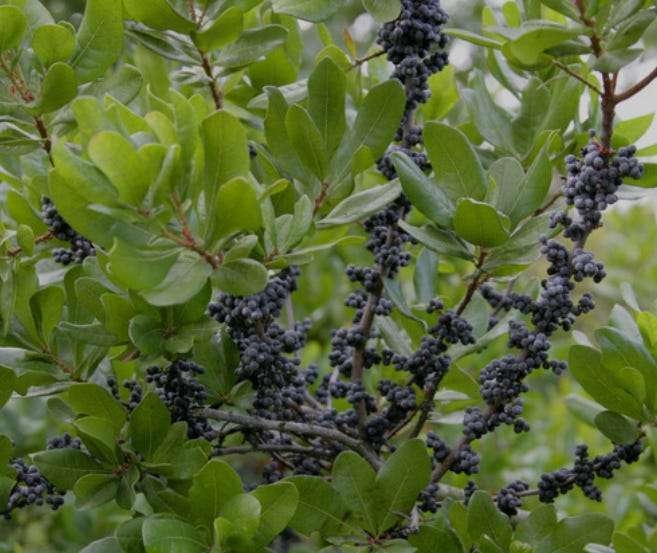
Better candles were available, made from the waxy bayberries that grew in Westchester. Bayberries could be crushed to make sweet-smelling candles. But since 15 pounds of berries yielded only one pound of wax, which only made a dozen candles…at a pound of berries per candle, they were saved for special occasions like Christmas, births, and weddings.
Bayberries46
Candle-making sounds to me like the worst task, if only because the result was so poor for so much work: the candles were smelly, they were smoky, and there were so few of them, despite all that labor, that they couldn’t have provided much good light.
Women’s Work
Elizabeth’s observation that “A man may work from sun to sun, but women’s work is never done” spoke to the reality of life in early Westchester. Men’s work usually required muscle and as such, was generally outdoor work done in daylight: chopping wood, felling trees, building barns, scything hay. Women’s work, on the other hand, could be done indoors and therefore constantly: cooking, feeding children, mending clothes, nursing the sick. Gender roles could bend out of necessity and were bent, in hard times such as war, when men were away, or natural disasters when the harvest had to be gotten in quickly. But the roles solidified when times were good.
For Sarah, the situation was even worse. The genealogies tell us that she had four sons before her two daughters were born to help her with the women’s work.47 Given that her neighbors were also family members, it is almost certain that she shared teenagers with others. Young people of both sexes lived with their kin, temporarily or not, to help and learn the necessary skills of adulthood. Between 1890 and 1930, Sarah’s great-granddaughter and great-great-granddaughter48 each spent years as servants in other people’s households. Later, when they had babies of their own, the roles reversed: they employed domestic help too, but drawn from their own relatives and sometimes paid only in room and board.49
The following chart is an estimate of Sarah’s hours of work on typical days thru-out the year in 1800, when she had newborn son Peter to care for. Sarah’s work hours are given in bold colors on the left hand bars. The work her children would have taken on are in corresponding bars on the right in pale colors. Because she had so many sons and so few daughters, the children generally added to her workload rather than cutting it.
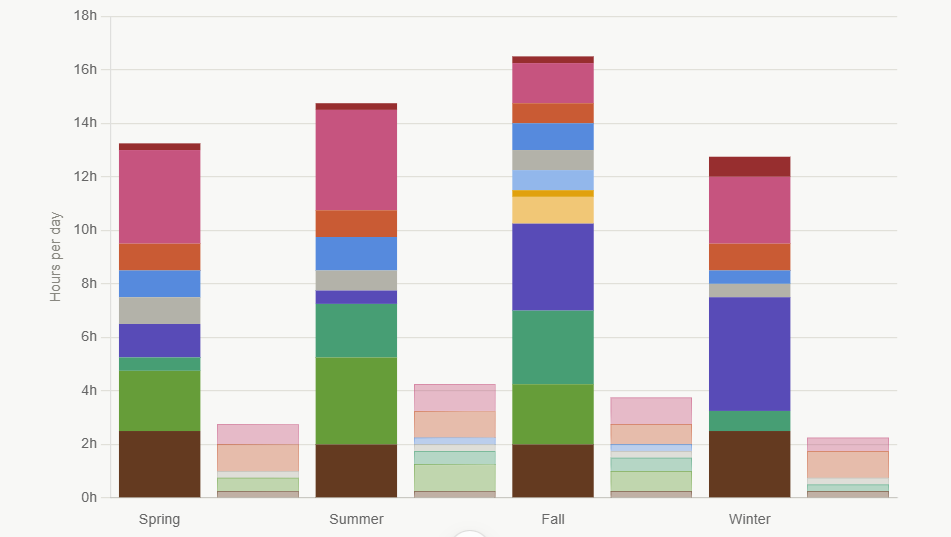

In 1800, Abraham and Isaac, 18 and possibly 15, generally handled heavy livestock and did fieldwork, which reduced Sarah’s need to milk cows and feed the animals. John and Jacob, about 10 and 8, could feed chickens and fetch eggs, water, and firewood. Elizabeth, age 7, could have minded five-year-old Sarah Junior and three-year-old Jeremiah Junior. The girls could have done basic mixing, churning butter, sweeping, and some washing. Winter would have seen the younger ones carding wool or helping hold or wind thread or yarn during spinning.
Fall, when butchering, harvesting, food preservation, candlemaking, and soapmaking were done, had the longest workdays. The retting of flax also took place in early fall. Summer, an ideal time for washing bedding, involved a lot of work growing crops, drying herbs and berries, and watching young children outside in the long hours of daylight. However, preparing fresh food for meals was easier. The bulk of making clothes occurred in winter, and nursing illnesses would naturally occur then too, but lack of light limited work hours. Chores in spring were more evenly distributed. Livestock care, housecleaning, and childcare were constants all year long.
Women and the work that was their domain is often invisible in history. But from literally giving life to feeding, clothing, and nursing people to preserve it, that women’s work was key to survival. Without Sarah’s work, I wouldn’t exist, and neither would my relatives in the six generations of Rushtons who came after her.
I used Claude.ai to help me analyze the terms of the land grant and research crops grown in the first years of the Cobequid grant. I used Claude.ai to estimate, calculate, and create a chart about the work Sarah would have done and the hours it would have taken, adding in the variables of the children’s sexes and ages.
Vincent, G. R. 46 Acres, 5 Hoggs, and a Family…North Cumberland Historical Society, Pugwash, NS, 1986
According to Vincent, by the late 1780s, there was talk of building a church
A family could clear about 4 acres a year, as told to me by Doug Sobey, Bedeque Historical Museum, Prince Edward Island
According to Vincent, boiling food saved fuel; Nova Scotians today eat a traditional boiled dinner. I enjoyed that meal cooked by my grandmother and her sisters.
Vincent
Vincent
My grandmother told me of her mother’s, Sarah’s great-granddaughter’s, amazing talent, knitting without looking, so I gave that talent to Sarah as well.
According to Vincent, moose largely left the Cobequid Mountains about 1800
https://www.myenglishpages.com/idiom/a-womans-work-is-never-done-meaning-and-examples/
https://en.wikipedia.org/wiki/Quit-rent
public domain
The Halifax Naval Yard and Mast Contractors, 1775-1815 Julian Gwyn https://www.cnrs-scrn.org/northern_mariner/vol11/nm_11_4_1to25.pdf
Conditions of grant in grant document, Jeremiah Ruftin in Nova Scotia Land Papers 1765-1809, Seaman, Stephen and others – 1785 – Cumberland County, Public Archives of Nova Scotia, https://archives.novascotia.ca/land-papers/archives/?ID=666&Doc=warrant
Fairbanks, Alaska, 1914, Asahel Curtis, https://commons.wikimedia.org/wiki/File:Buckwheat_field,_Fairbanks,_ca_1914_(CURTIS_1953).jpeg
.jpeg)
https://journals.lib.unb.ca/index.php/Acadiensis/article/download/10723/11441?inline=1
https://www.motherearthnews.com/organic-gardening/growing-calories/
Adobe stock photo
https://novascotia.ca/agri/documents/education/resources_NSFarmPRF16.pdf
Vincent
Pictyl open source image
Will of John Rushton, proved 10 July 1800, Probate Records Old Wills: Cumberland. Probate Indexes 1789–1945, Familysearch
Illawarra Historical Society and Museum , Creative Commons, https://ehive.com/collections/7080/objects/861094/hand-powered-grist-mill
Vincent
Hincks--Irish linen, 1791, plate 1 (B size) [P&P], Repository: Library of Congress Prints and Photographs Division Washington, DC, /https://www.loc.gov/pictures/item/2003674107/
Bogstad Manor, Norway, https://commons.wikimedia.org/wiki/Category:Flaxfields#/media/FileLinumusitatissimum01.jpg
Hincks--Irish linen, 1791, plate 3 (B size) [P&P], Repository: Library of Congress Prints and Photographs Division Washington, DC, https://www.loc.gov/pictures/item/2003674101/
https://exquisitemachinery.com/category/antique-flax-processing-tools/
https://exquisitemachinery.com/category/antique-flax-processing-tools/
1978.4.22, Museum Collection, The Filson Historical Society, Louisville, Kentucky,https://filsonhistorical.omeka.net/items/show/5823
https://www.nps.gov/jame/learn/historyculture/flax-production-in-the-seventeenth-century.htm
This wonderful website describes flax processing better than I ever could. https://exquisitemachinery.com/category/antique-flax-processing-tools/
William Hincks,1791, Irish linen, plate 4 (B size) [P&P]Repository: Library of Congress Prints and Photographs Division Washington, D.C., https://www.loc.gov/pictures/item/96507883/
Hincks--Irish linen,1791, plate 6 (B size) [P&P]Repository: Library of Congress Prints and Photographs Division Washington, D.C.https://www.loc.gov/pictures/item/2003674103/
Detail of an illustration created by Brewminate with AI, Creative Commons Attribution-NonCommercial-NoDerivatives 4.0 International license
https://research.colonialwilliamsburg.org/foundation/journal/Winter15/hemp.cfm
https://brewminate.com/hemp-in-early-america-labor-textiles-maritime-power-and-national-identity/
Woman Carding Wool, Jean-Francois Millet, Original Title: La Cardeuse, c.1855, https://www.wikiart.org/en/jean-francois-millet/woman-carding-wool
Will of Hanness Coon, probated 28 April 1773, Record of Wills, 1665-1916; Index to Wills, 1662-1923 (New York County); Author: New York. Surrogate’s Court (New York County); Probate Place: New York, New York, Ancestry.com
Plate 29, Spinning and carding wool, George Walker, “The Costume of Yorkshire, 1814 University of Leeds | University Library Special Collections, https://en.wikipedia.org/wiki/The_Costume_of_Yorkshire,
https://hudsonvalley.org/article/spinning-yarn-how-colonial-americans-made-textiles-wool/
Drawings by Arthur Ellis, https://www.garyolds.com/files/ColonialSoapMaking--HistoryTechniques.pdf
https://www.garyolds.com/files/ColonialSoapMaking--HistoryTechniques.pdf
https://stock.adobe.com/search?k=old+candle
https://www.gettyimages.com/photos/colonial-candle-making
Vincent
https://www.alamy.com/stock-photo/bayberry.html
A. Spinster, meaning a person who spins thread, was so associated with females that it evolved into meaning an unmarried woman
B. Cumberland County Genealogies, Westchester Township Book, archives.novascotia.ca
my grandmother and great-grandmother
Censuses of 1891, 1901, 1911, 1920, 1930
Comments
Post a Comment