A Pilot
It was probably a good thing William was not still mustered with the Armed Boatmen. They were not one of the regiments recommended by Sir Guy Carleton, the British general in charge of the surrender, to receive land grants from the Crown for their service in the war.25
(See Part 1, William Rowland, Armed Boatman, see Acker Pedigree Chart, see Rowland Family Descendant Chart)
But William did get a land grant. He was one of only 15 men to be personally ordered a land grant by Rear Admiral Digby of the British Navy, who had been sent to manage the British withdrawal, because of his service to the King as a pilot.26
A pilot? When was William a pilot? Is that was he was doing in 1783 when he was not on the muster roll?
Maybe. I don’t know, but he had to have been a pilot sometime during the war, and his service had to have been important enough to warrant a land grant, as well as come to the attention of no less a person than the Rear Admiral of the entire British Navy in North America.
In addition, a 1782 muster roll of the Armed Boatmen says that William was absent due to being on the Amphion between the 15th of September and the 24th of November.27 What was the Amphion?
The Amphion was a British warship, a fifth-rate frigate with 32 guns that had been built two years before. It had participated in traitor Benedict Arnold’s attack on New London, Connecticut, when he was a British officer. It had recaptured the British sloop Bonetta that had been lost at the Battle of Yorktown.28 William wasn’t present on the Amphion during those exploits, but it was certainly an active and effective warship.
I wonder if he was lent to the ship to act as its pilot.
What was the job of a pilot?
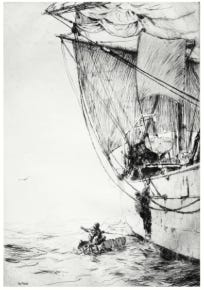
Pundol, Lara, A Maritime Pilot Boarding a Ship
Pilots took over from captains to steer ships thru tricky local waterways. Then as now, they approached the larger vessel in small craft and boarded by way of a ladder up the side. Pilots were necessary to bring ships into harbors and up rivers. They were especially important in the uncertainty of wartime, when British captains would not know which passages were safe, whether maps were accurate, or if rebels had planted booby-traps. Surely, in their nightmares, captains saw themselves in the disaster of the Gaspee, a British ship burnt to the waterline by rebels, its crew captured and captain shot, when it lay helpless, run aground in Newport Harbor in 1777.29
Being a pilot required intelligence, daring, intuition, knowledge, and above all, the confidence to assume command far above the pilot’s social station. It required ordering captains around. It meant earning the respect of an entire battle-hardened crew. It meant steering a vessel worth more money than you and all your neighbors would see in a lifetime. And it required being right when making life-and-death choices.
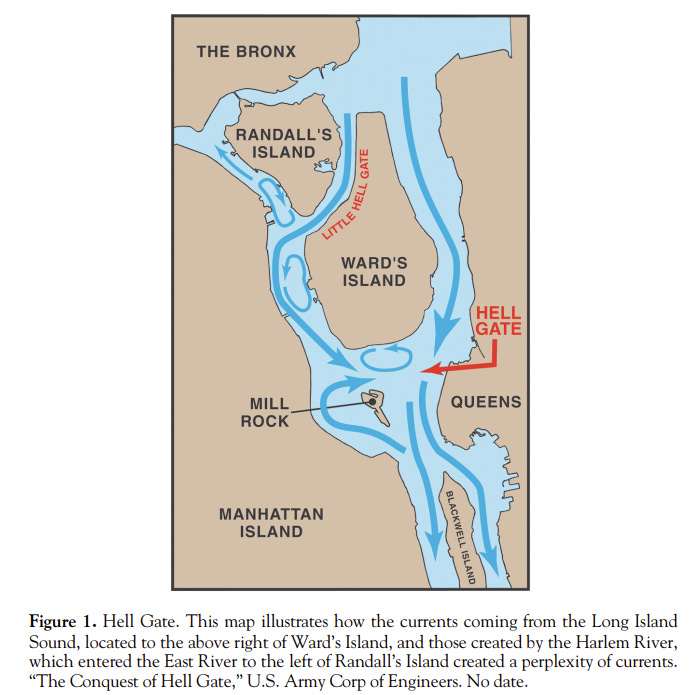
https://sites.ucmerced.edu/files/kdawson4/files/enslaved_ship_pilots_in_the_age_of_revolutions_2.pdf
Like Frank Sinatra sang of New York, if you can make it there, you can make it anywhere. Because New York Harbor included the aptly named Hell Gate, a narrow strait of submerged rocks hidden beneath the tides and currents of three converging waterways, just waiting to mutilate the unwary. Even tho the original name Helle Gat is Dutch for Bright Opening, the multitude of shipwrecks made the Anglicized version stick.30
Pilots were so respected, even those who were slaves were deferred to by white sea captains as well as crew.31 Many pilots were black, which may go hand-in-hand with the integrated nature of the Armed Boatmen.
William Rowland was a pilot during and after the Revolution, so it makes sense that he could have also been a pilot before it started. Piloting was on-again-off-again work, not a permanent job. A pilot’s permanent job needed to be on the water, where he could gain the intricate yet ever-changing knowledge he would steer ships by. A pilot was most likely a fisherman, ferryman, or oarsman, operating a boat low to the water where every wave was felt and every rock spotted.32
That means William lived somewhere in the vicinity of New York Harbor,33 close enough to be familiar with the variations of the winds, tides, and water tables. He knew when the neap tide of a waxing crescent would hold enough water to allow the draft of a ship carrying however much cargo to make it past reefs and sandbars to port. When was it safe to make a run for it? When was it necessary to ride anchor? And which tack to take if the enemy was chasing you? Or would it be feasible to attack a foe?
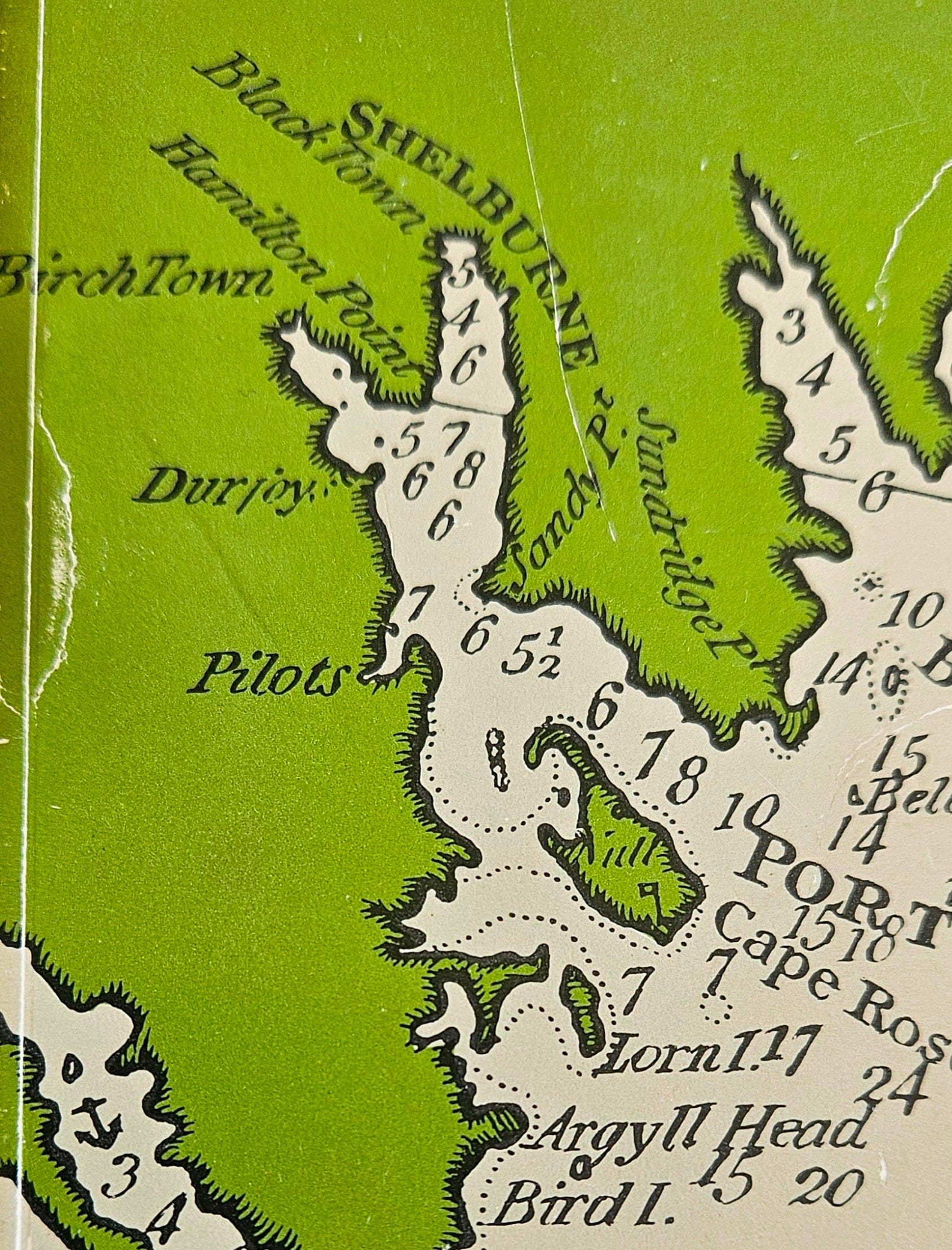
map indicating Pilot Town on Shelburne Harbor, portion of “A New Chart of the Coast of Nova Scotia…” by Capt. Holland, 1798, Provincial Map Collection, Public Archives of Nova Scotia, Robertson, Marion, King’s Bounty, Nova Scotia Museum, Halifax, 1983, cover
Land Grants after the War
Britain rewarded Americans who had remained loyal to the Crown and thereby lost their property by giving them land grants in British colonies. William and the other fourteen pilots whom the admiral had deemed deserving of land grants had arrived in Shelburne, Nova Scotia by September 1783, along with tens of thousands of other refugees. Admiral Digby had requested the pilots be allotted land there,34 probably because Shelburne has the third best harbor in the world.35 On account of that harbor, the British intended for Shelburne to become a great city. Altho the admiral allowed for the pilots to get land wherever they wished, surely he expected them to be key players in the port’s development.
On October 2, land for the pilots was surveyed at Gunning Cove on the west side of the harbor. William and five others claimed 50-acre farm lots behind a village laid out with the name Pilot Town. The village was made up of 24 lots along the shore, plus a lot each for church, school, and public use. Even a 60-foot-wide road was included. The pilots received half of their wartime pay,36 which I think lasted between one and three years. I now own a house near William’s land.
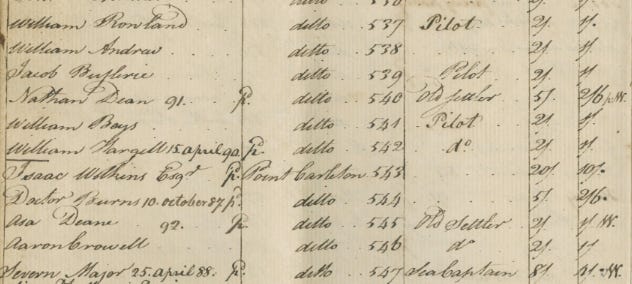
first line, William Rowland, at Round Bay, pilot, paid 2 pounds county tax, 1 shilling poor tax
last line, Severn Major, paid on 25 April 1788, at Point Carleton, sea captain, paid 8 pounds county tax, 4 shillings poor tax W. Severn Major was a lieutenant in William’s Company of Armed Boatmen37
A 1787 visitor wrote an opinion of the pilots: “No people among the Loyalists have exerted themselves more successfully than they in rendering their present situation comfortable.”38
Almost ten years after the war’s end, William earned his living as a pilot and paid one pound county taxes and 6 shillings poor tax, the same as his pilot neighbors, which was on the low end for the area. As the years went on, he and all his pilot neighbors but one began to be labeled as farmers or laborers. The one man who remained a pilot earned a half-pay annuity of 40 pounds.39 Shelburne never lived up to its promise as a great seaport; its population dwindled and there was no need for pilots to guide fleets that never came.
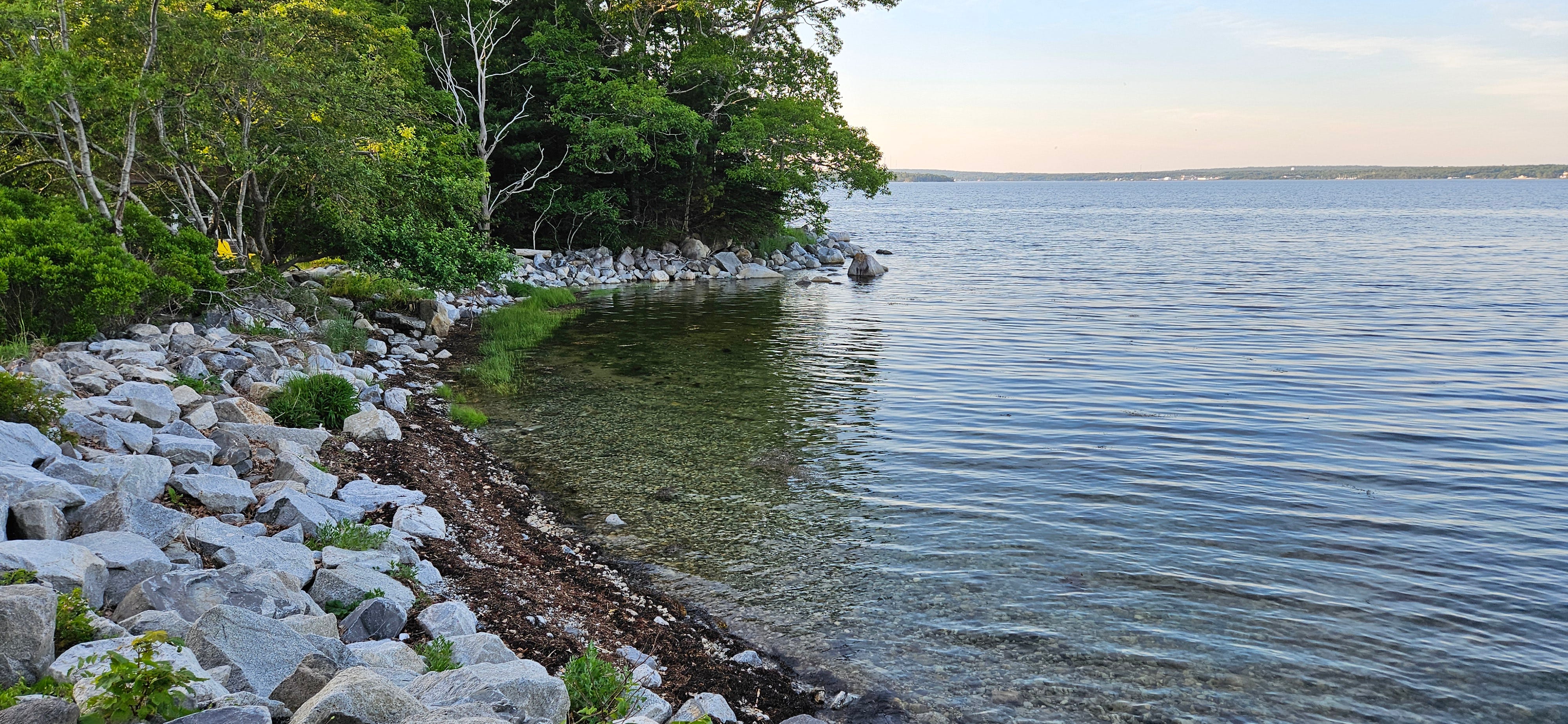
the shore near Gunning Cove today, photo by author
Epilogue
William died at home in August 1813 at the age of 71. I only know of four children born to him and his wife Rachel, all daughters: Ann, Felicia, Mary, and Eleanor (Nelly), all born in Gunning Cove.40 If they had children before coming to Nova Scotia, I have not found them in records. Without sons, the family carried Rowland into the future as a middle name, giving it to both male and female descendants, until it finally vanished.
Because it’s hiding behind first and last names in the tree leaves, I didn’t find Rowland to explore until later. It seemed less important somehow. But I ended up discovering that William’s wartime service is the best documented of all my Loyalist ancestors. So far he is the bravest and most skilled.
He is long overdue for his story to be told.
Footnotes:
Robertson, Marion, King’s Bounty, Nova Scotia Museum, Halifax, 1983, pp. 72-73.
Muster Roll
https://en.wikipedia.org/wiki/HMS_Amphion_(1780)
See my post on Joseph Durfee, https://grandmasgrannysfamilyalbum.substack.com/p/captain-joseph-durfee-1725-1801
https://en.wikipedia.org/wiki/Hell_Gate
https://sites.ucmerced.edu/files/kdawson4/files/enslaved_ship_pilots_in_the_age_of_revolutions_2.pdf
https://sites.ucmerced.edu/files/kdawson4/files/enslaved_ship_pilots_in_the_age_of_revolutions_2.pdf
Many trees have William and Rachel Rowland originating in Delaware. This is erroneous, as that couple goes on to live in Delaware after the Revolution. Furthermore, a Delaware native would not have detailed knowledge of New York waterways.
Robertson
https://shelburnens.ca/about-port.html
Robertson
Poll Tax Records 1791-1795, Nova Scotia Archives, archives.novascotia.ca
Robertson
Poll Tax Records
Anglican Church Records of Shelburne County, Public Archives of Nova Scotia
Other Sources Consulted:
https://www.monmouthhistory.org/250/the-bold-privateering-of-adam-hyler
https://en.wikipedia.org/wiki/Whaleboat_War
https://www.singlesundersail.org/wp-content/uploads/2021/04/Whaleboat-Presentation-2-25-2021.pdf
https://patch.com/new-jersey/tomsriver/the-battle-of-toms-river
https://www.hmdb.org/m.asp?m=139167
https://en.wikipedia.org/wiki/Armed_Boat_Company
http://admiraldigbymuseum.ca/?page_id=46
https://www.monmouthhistory.org/250/davenports-pine-robbers-routed-at-forked-river
https://philadelphiaencyclopedia.org/essays/salt-making/
Comments
Post a Comment