As I wrote about Sarah, she came to life...I got to know her as a person. I came to know what she would say next, what she would do. As I wrote her voice, I heard it in my head. Listening to it, I realized it was the voices of her great-great-granddaughters, who grew up in the county she made home...Nana (Bessie), Aunt Eva, Aunt Anna, Aunt Helena, Aunt Connie. The voices I grew up hearing, telling stories of their lives.
(see Rushton Pedigree Chart, Sarah Hall & Jeremiah Rushton Descendant Chart, Revolutionary Cowboy in New York ~ Jeremiah Rushton Stole for King and Country Parts One and Two)
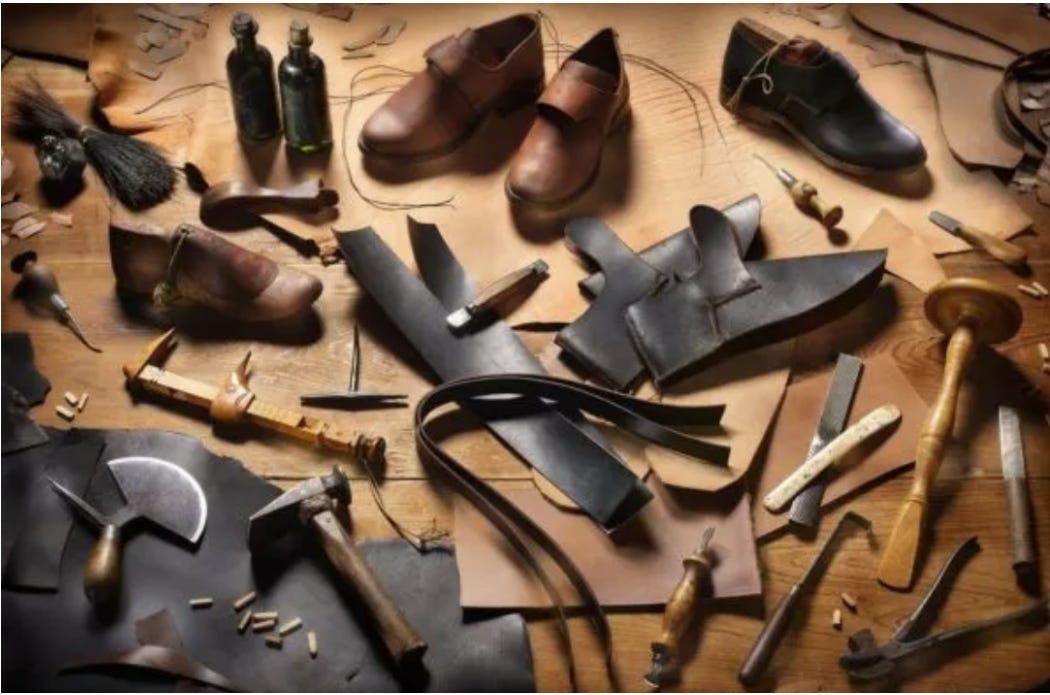
The Story of the Cordwainer’s Wife….a fictional look
Westchester, Nova Scotia, about 1827
“This is my favorite spot on all of our land grant.” Sarah Rushton spread her arms across the small peninsula fashioned by the U-curve of the meadow brook.1 She looked at her daughter Elizabeth, walking the path beside her as the children2 played hide-and-go-seek between trees and behind bushes.
“I need to walk,” Elizabeth sighed. “My back hurts from sitting, and it’s hard to get up and down.”
“The last months are the worst,” Sarah agreed. “Is it easier in the evenings, when the older girls are home from school? They could stay home and help you, but it’s good they learn to read and write.3 I didn’t.”
“They do help, but by that time I’m so tired, I just want to lie down. And I like the quiet of just the little ones to worry about. Especially at nap time.”
“We can go back whenever you want,” Sarah offered.
“No, I need to tire them out so they’ll nap. Or at least rest,” Elizabeth replied. “And this is a nice smooth path to walk.”
“Your younger brothers built me this path. It was their first trial at clearing trees to build something. I was so proud of them when the path was finished.”
“Yes, Mama, you’ve told us this before,” Elizabeth said wryly.
“Oh have I?” Sarah’s eyes twinkled.
She paused. “I hope when you remove to Upper Canady, you find a favorite spot too,” she said softly.
But Elizabeth stopped short. “Mama! What?”
“You think I don’t know? You think your father and all six of your brothers4 haven’t been talking about your husband’s plans for the last year?”
Elizabeth walked a few steps away. “Lucy! Come out where I can see you!” she called. The two-year-old’s head popped atop a bush. “All right; you can go back and hide.”
“Times are not as good as they were when you were a child. You need to go where the land is more fertile. You need land that’s good and level, not like here in the Cobequid Mountains,” Sarah went on calmly.
“I don’t want to leave home,” Elizabeth mumbled, looking at the pebbles beneath her feet.
“Do you think I wanted to leave New York? Everybody and everything I knew? Your father and I had what looked like it could be a good business making shoes. We looked forward to a bright future. There was always something going on in the city, something new every day, different people coming into the shop to talk to.”
“I don’t think you are recollecting clearly, Mama,” Elizabeth replied. “There was a war going on. Papa was away fighting with the Westchester Refugees. You had to leave. What bright future could you possibly have looked forward to?”
“Pffftt!” Sarah spat. “The bright future we thought we were going to have. Wars end. People have to come to their senses eventually. We thought peace would finally be declared, the soldiers would leave, and we’d all go back to our homes. Rebuild what was in ruins. Start again.”
“But they didn’t come to their senses, Mama,” Elizabeth protested. “You had to leave. The rebels took everything: stole Grampa’s shop, burned Grannie’s house, turned them off their farm. They said you’d never get anything back that you lost.”
“You’re right,” Sarah conceded. “I was wrong to think it would go back to normal at the end. I was always afraid your father would be killed while he was out raiding, but after Colonel DeLancey went to England and the whole regiment was disbanded, I was afraid he’d be hanged for treason. It didn’t mean I wanted to leave, tho.”
A Chronicle of a Cordwainer’s Wife….a factual account
The Sarah described above married Jeremiah Rushton about 1781,5 perhaps before he enlisted with Colonel James DeLancey’s Westchester Refugees in March. Nicknamed Cowboys for their skill at stealing cattle, the Refugees were an irregular regiment committing guerrilla warfare in Westchester County, New York. Jeremiah joined with his own horse, gun, and clothing,6 as the Refugees had no uniforms. They received no pay; they were expected to support themselves or plunder the homes and farms of Patriots. Indeed, they were called Refugees because they had been driven out or burned out of their own homes; their land and possessions had been confiscated by the new rebel government.7
Before she was married, Sarah of course had a family, the Halls, with political beliefs of their own. But I have not found records to show where they were from or what those beliefs were. There were no Halls among the Refugees who were exiled to Westchester, Nova Scotia,8 suggesting they may have fallen on the rebel side of the spectrum of belief in the colonies. Sarah may have chosen to forsake her family when she fled; possibly even when she married. As a middle-class woman she did not need her father’s permission to marry, and her father’s opinion would not have figured highly in her dowry, the wealth a woman brought into a marriage. Sarah’s mother would have had more influence in her dowry, which likely consisted of necessary household items: bedding, kitchenware, small furniture.9
Some families in this time period maintained ties despite differing allegiances; others ruptured.10 Maintaining ties with her birth family would have been difficult for Sarah if they weren’t also living within the city. She couldn’t read or write,11 and there was no safe travel in and out of New York City, which the British Army occupied. If the Halls lived outside of its boundaries, there would have been no crossing enemy lines.
Sarah may have already known her future husband when, in the winter of 1777, Jeremiah, his father John and brother Peter, along with many others, took the oath of allegiance to King George in New York City at the request of Royal Governor Tryon. At that time, Jeremiah was apprenticed to a cordwainer; Peter and John were farmers.12 The Rushton family lived in Rye, on the Connecticut border but only about twenty miles from the city line. The Rushtons may have moved into the city by that time or they may have still lived in Rye; John did so much business in the city that he voted and served on a jury there while renting his farm and shop in Rye. He probably did so because the city allowed civic participation without owning land, whereas Rye voters had to be landowners.13 John was a saddler as well as a farmer; most artisans in Rye farmed in addition to selling products of their craft.14
During the War, the city limits were only the southern tip of Manhattan Island. About thirty thousand Loyalists and army personnel were jammed into that space. A fire in 1776 had destroyed much available housing, further jacking up prices. Many people lived in Canvas Town, tents erected among the ashes.15 Black Loyalists, escaped slaves and free blacks who worked for the army, occupied the city center.16 Fresh food entering came from Loyalist Long Island, but supplies were often raided by Patriot fighters in whaleboats.17
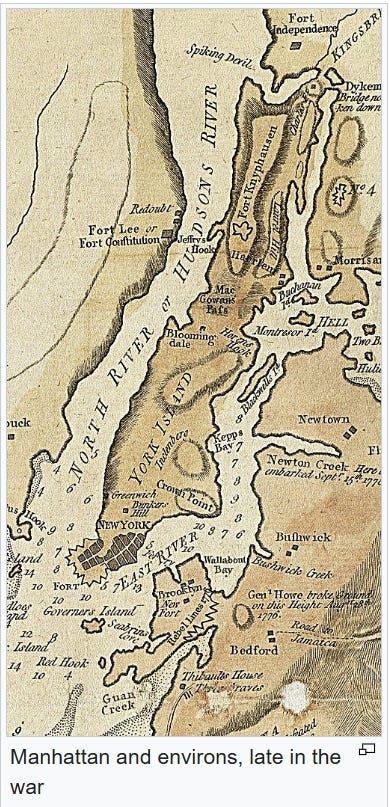
the dark blocks at the tip of York Island indicates the population center
Sarah had probably expected to be the wife of a fairly prosperous cordwainer. A cordwainer, so called after the fine leather of Cordoba, Spain, crafted entire shoes from quality leather; it required five more years of apprenticeship than a cobbler, who only repaired shoes. The skills, tools, and materials of a cordwainer did not differ too much from that of a saddler; Jeremiah may have even served his apprenticeship at his father’s shop. (One stitch used in both trades has two names: it is called both the shoemaker’s stitch and the saddler’s stitch).18 While John’s customers were wealthy since not many people could afford horses, Jeremiah’s customers would have come from every walk of life. It is conceivable that their clients overlapped.
When New York City’s population swelled, the number of shoes needed would have too. Jeremiah probably did a booming business; the whole family may have turned to cordwaining, as the trades were so similar that all the Rushtons were likely able to perform both.19
Cordwaining was a good profession for a family. Cordwainers’ shops occupied space in their own homes. Since housing in the city was so scarce, Jeremiah and Sarah probably lived with his parents and six younger siblings, and maybe even his older brother Peter, who had a wife Catherine and children by then.20 Customers ordered shoes in advance;21 Sarah or her mother-in-law Mary would have waited on customers and someone who could write would have kept track of orders.
Shoes were made by fitting leather over molds called lasts. They look like wooden feet to me. Shoes were neither right nor left but straight, meaning they fit on either foot. Most shoes were made for walking long distances.
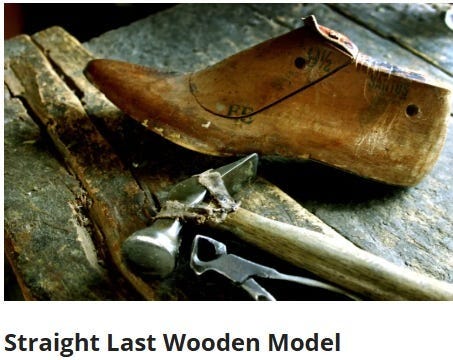
A wooden straight last22
Leather was scraped over a wooden beam until it was thin enough to sew into the right type of shoe. The smooth side became the inside. First, the leather was cut out. Sarah’s contribution most likely came when the top, called the vamp, and the sections were sewn together, as those were the tasks most often done by women. They were fitted on the last to determine size. Two soles and a heel were attached. Last, the rough outside was polished with a combination of soot, beeswax, bear grease, and lard.23
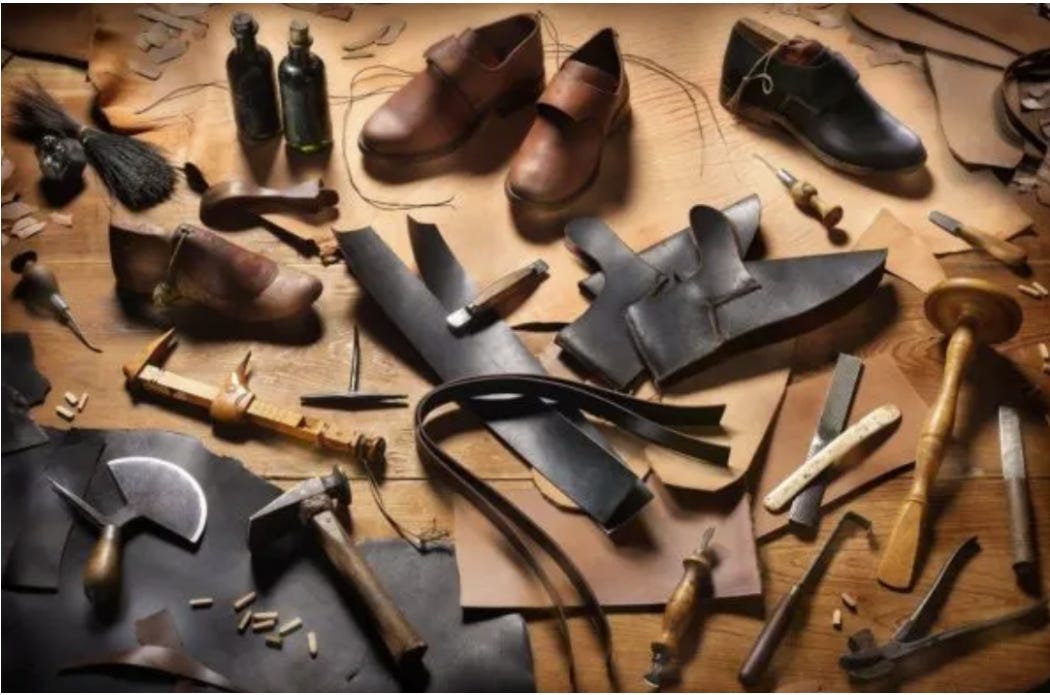
Cordwaining tools24
Since housing was at such a premium, I imagine five adults and five teenagers cordwaining in the same building, maybe a three-story attached structure. The area where Sarah, Mary, and Catherine would have received customers would front the shop that held the workbenches, tools, and curing beam.
It is reasonable to assume that the Rushtons had silver money from their earnings as cordwainers and saddlers in New York City, where a captive population in need of shoes provided a steady custom with access to British silver.25 In the 1700s, the average price of a pair of shoes was about one day’s wages for the average journeyman.26 New Hampshire records show that in 1785, making a pair of boots or shoes was equated in value to a day’s work in haying or reaping.27 Altho we need to keep in mind that the eight years of wartime inflation would have altered this, New York City journeyman carpenters generally offered to work for 9 shillings a day thru-out the 1700s and 1800s.28
If the adults in the household, with the help of teenage apprentices, averaged one pair of shoes a day,29 that’s 5 pairs a day. At roughly 9 shillings a pair, that comes to 45 shillings, or about 2¼ pounds, in gross income per day. If the high cost of leather took up an estimated three-quarters of of that,30 the Rushtons would have netted around 11 shillings a day. Over a 300-day working year, that’s roughly 170 pounds. If they carried on this business from the winter of 1777, when they signed the oath of allegiance, until they left New York in June 1783, they may have put aside just over 1,000 pounds of British sterling by the end of the occupation. However, the cost of living in the wartime city was extremely high, as it wasn’t safe to leave, everything had to be imported, and all imports were subject to attack.
Many variables enter into the question: how much coin money do we think the Rushton family had when they were exiled from New York?
Of course, while soles were hammered and customers’ wants were satisfied, the daily business of a family went on. Keeping the large family shod was covered, but keeping them fed, clean, clothed, and healthy was the daily struggle undertaken by women. Between shopping for the food coming into the city and preparing it, washing clothes in a kettle of hot water against the constant soot and filth of a crowded space, sewing and mending garments for growing children, the labor would have revolved on a constant wheel. Keeping children alive against disease carried by densely populated newcomers was a challenge that the Rushton women apparently met; altho no records show if any died, early censuses count the many children they brought to Nova Scotia.31
Crown Land Grant Map 70, Crown Land Information Management Centre, https://novascotia.ca/natr/land/indexmaps/070.pdf
Westchester Township Book Genealogies
Fergusson, Charles Bruce, Provincial Archivist, The Inauguration of the Free School System in Nova Scotia, Public Archives of Nova Scotia, 1964
Westchester Township Book Genealogies
Westchester Township Book Genealogies
Jeremiah Rushton, Memorial, Coldham, Peter Wilson, American (Loyalist) Migrations 1765-1799, p. 330
“James DeLancey Attributed to John Durand ca. 1778-1782,” Society of the Cincinnati. https://www.americanrevolutioninstitute.org/asset/james-delancey-attributed-to-john-durand-ca-1778-1782/#:~:text=BythefallCColonelDeLancey,theirpropertyconfiscatedbypatriots. Accessed January 2026.
Gilroy, Marion, compiled by, Loyalists and Land Settlement in Nova Scotia, Cumberland County Grants, Public Archives of Nova Scotia.
Gardner, Andrew G., Courtship, Sex, and the Single Colonist, https://research.colonialwilliamsburg.org/Foundation/journal/Holiday07/court.cfm
Wulf, Karin A.,”Despise the mean Distinctions [these] Times Have Made”: The Complexity of Patriotism and Quaker Loyalism in One Pennsylvania Family,American University, https://revolution.h-net.msu.edu/essays/wulf.html
Sarah signed by her mark, Deed of Sale between Jeremiah Rushton and his wife Sarah Rushton and Andrew McKim, 20 June 1814, Cumberland, Nova Scotia, Canada Deeds 1798–1801, 1801–1815, 1815–1822, Volume E-G. Cumberland County (Nova Scotia). Registrar of Deeds, Image Group Number 008189355, "Cumberland, Nova Scotia, Canada records,” images, FamilySearch (https://www.familysearch.org/ark:/61903/3:1:3Q9M-CSLZ-BQHZ-6?view=explore : Jun 15, 2026), image 306 of 575
Burns, Brendan S. The Loyal and Doubtful, Index to the Acts of British Loyalism in the Greater New York and Long Island Area, Vol. 4. 2023. Rushton, Jeremiah. Oath of Fidelity to King George 1777
Pamela McGuire, Revolutionary Rye 250, The Stirrings of Resistance, Resistance Comes to Rye, presentation on 3 February 2026
https://www.newyorkalmanack.com/2023/08/british-occupation-new-york-city/
Hill, Lawrence, The Book of Negroes, HarperCollins, 2007
https://en.wikipedia.org/wiki/Armed_Boat_Company
https://shoemaking.wiki/Shoemaker_Stitch
Gill, Harold P. Jr., Leather Workers in Colonial Virginia, 1966, p. 43, Colonial Williamsburg Foundation Library Research Report Series - 0107, Colonial Williamsburg Foundation Library, Williamsburg, Virginia, 1990
Cumberland County Genealogies, Westchester Township Book
https://www.grunge.com/493950/what-life-was-like-as-a-shoemaker-in-the-colonial-era/
Image from https://revolutionarywarjournal.com/cordwainers/
https://revolutionarywarjournal.com/cordwainers/
Image from https://revolutionarywarjournal.com/cordwainers/
https://www.newyorkalmanack.com/2023/08/british-occupation-new-york-city/
https://en.wikipedia.org/wiki/Shoemaking
(University of Missouri Libraries’ “Prices and Wages by Decade” guide, which cites the 1872 Report of Commissioners on the Bureau of Labor Statistics to the New Hampshire Legislature as listing, for 1785, “a day’s work in haying and reaping” as equivalent in value to “making a pair of boots or shoes.”)
"Historical Money Equivalents: 18th and 19th Century Wages," hosted by the Old Stone Fort museum (theoldstonefort.org), (New York shillings were eight to a dollar, making the wage $1.12½ per day.)
https://twonerdyhistorygirls.blogspot.com/2010/10/crafting-shoes-for-18th-century-lady.html
https://revolutionarywarjournal.com/cordwainers/
1791, Poll Tax Records, https://archives.novascotia.ca/census/polltax/
Comments
Post a Comment