
The Black Loyalists suffer a double whammy in American history…they supported the losing side in our origin story, and they don’t fit our founding myth that the Declaration of Independence declared all men are created equal and deserve life, liberty, and the pursuit of happiness. Or that we’re the good guys.
The Virginia Proclamation is not in the Virginia public school curriculum. Patrick Henry’s speech advocating independence from England, given at St. John’s Church in Richmond, is.1
"Is life so dear, or peace so sweet, as to be purchased at the price of chains and slavery? Forbid it, Almighty God! I know not what course others may take; but as for me, give me liberty or give me death!"2
It is obvious to everyone who hears it that Patrick Henry, a slaveholder, held some cognitive dissonance he probably didn’t even notice.
All the slaveowning patriots…George Washington, Thomas Jefferson, James Madison, et al…believed the same paradox.
One man decided to exploit that paradox.
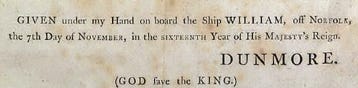
The Virginia Proclamation
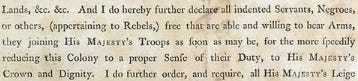
The Black Loyalists’ story began when John Murray, the Earl of Dunmore, Royal Governor of Virginia, came up with a brilliant plan to thwart the pesky colonists making noises about rebellion. He set able-bodied male slaves free. All they had to do was get to him.
To Dunmore’s mind, the plan had many possible positive outcomes:
It would deprive plantation owners of field laborers, forcing them to stay home and work their fields themselves and stop meeting in Williamsburg to plot rebellions.
It would cost slaveowners money, as one able-bodied man could fetch hundreds of dollars in a slave auction.3
It would force the colonists to stay home to make sure their slaves didn’t run away.
It would supply the British army with manpower, freeing their soldiers to fight rather than dig ditches.
It would disrupt society.
“And I do hereby further declare all indented Servants, Negroes, and others, (appertaining to Rebels), free that are able and willing to bear Arms, they joining His MAJESTY’S Troops as soon as may be…”4
The plan didn’t end up helping Dunmore, who fled Virginia in 1776.5 But for black Virginians, the Virginia Proclamation he issued in November 1775 worked even better than he had anticipated. The numbers were incredible. Men, their families threatened with punishment, brought their wives and children, adding cooks, laundresses, and nurses to the army. In two short months, between 800 and 3000 blacks reached the British line in Virginia alone, including 40 who escaped from George Washington.
In only one month, 300 to 800 men made it to the British Army, becoming the first African-American regiment in US history, the Royal Ethiopian Regiment. Enlisted men were even paid one pound, one guinea for joining. Their uniforms displayed their purpose: the words “Liberty to Slaves."6
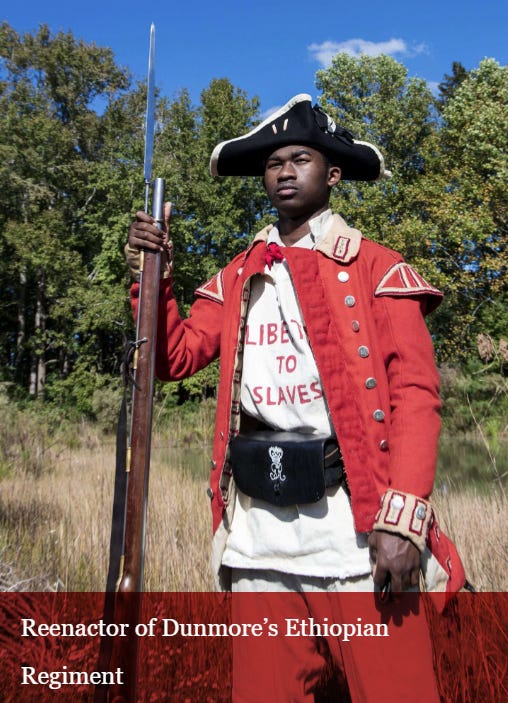
image from Lawler, Andrew. "Lord Dunmore’s Ethiopian Regiment" Encyclopedia Virginia. Virginia Humanities, (17 Feb. 2025). Web. 04 Jul. 2026
The Royal Ethiopians fought in two battles: the Battle of Kemp’s Landing and the Battle of Great Bridge. They prevailed in the first, with one former slave even capturing his previous owner.
But Dunmore was defeated and driven from Virginia in the second. Many of the Royal Ethiopians died of typhus and malaria;7 the others moved north and regrouped into the Black Pioneers.8
Dunmore only had jurisdiction over Virginia. But the Virginia Proclamation had been printed all over the colonies.9 Twenty thousand slaves would gain freedom during the war.10 The dam had burst.
The Philipsburgh Proclamation
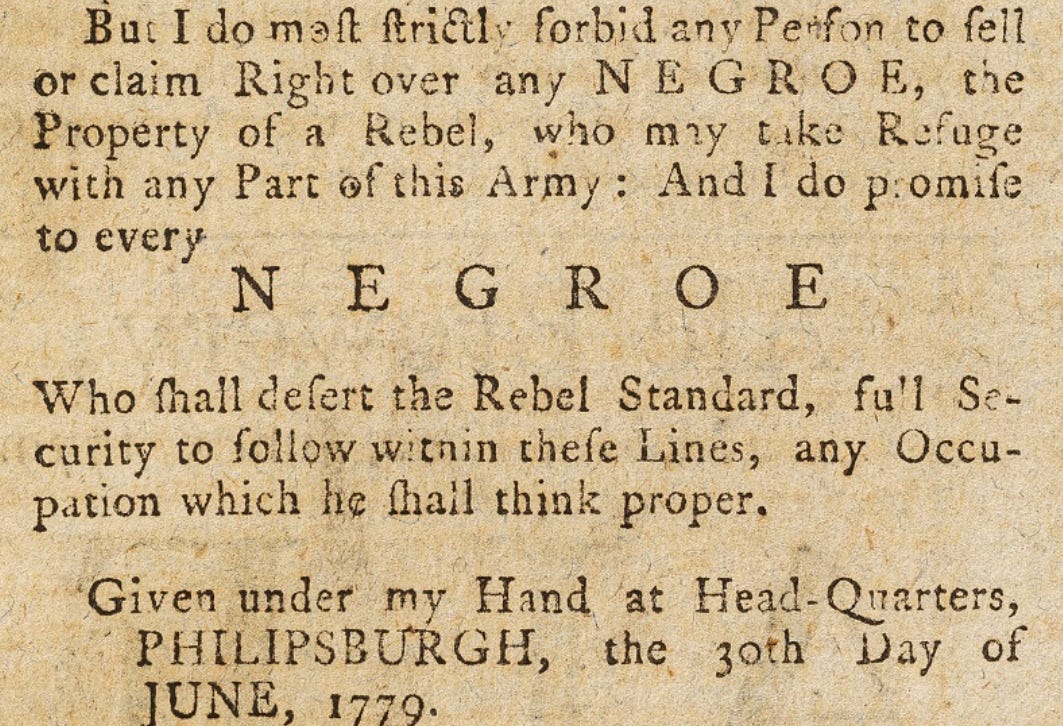
The potential to be free exploded in 1779 when the Philipsburgh Proclamation was issued by Sir Henry Clinton, Commander in Chief of the British Army, headquartered in New York. It promised freedom and protection:
“I do most strictly forbid any Person to sell or claim Right over any NEGROE, the Property of a Rebel, who may take Refuge with any Part of this Army.”11
Moreover, the Philipsburgh Proclamation welcomed both men and women, with their children. It gave them the opportunity to follow, within the army, “any Occupation he shall think proper.”12 Enslaved people weren’t used to acting as a family; they weren’t used to having a choice; and they certainly weren’t used to being asked their opinion as to what they thought proper.
Written as war measures, the proclamations freed the slaves held by rebels, not Loyalists. However, the majority of southern independence-seekers were large plantation owners from the eastern Tidewater. Americans living upcountry in the frontier had different interests than the coastal elites. They were naturally in opposition to the rich, so they were Loyalists. And they didn’t have slaves.
Furthermore, the proclamations angered slaveholders and drove them into the rebel camp. The Declaration of Independence specifically lists that King George “has excited domestic insurrections against us” as one of the grievances causing America to break away from England.13
Free blacks worked for the army also. The Loyalist raiders along the New Jersey coast were integrated, many blacks being pilots. (See my post on my 4th great-grandfather William Rowland, Armed Boatman)
Escaped slaves took advantage of the chaos to move wherever they wanted. The numbers of slaves who fled bondage to work for the British Army vary widely. That’s to be expected in a time without data, during a war, with propaganda on both sides. But it was definitely the biggest drop in slavery as a whole until the Civil War.
Famous Black Loyalists include:
Colonel Tye, military commander of the powerful Black Brigade in New Jersey14
Boston King, widely-published author, soldier, missionary, and a founder of Sierra Leone15
Harry Washington, escapee from George, soldier in the Royal Ethiopian Regiment and Black Pioneers who fought at Charlestown, settler of Birchtown, Nova Scotia, reformer in Sierra Leone16
Rose Fortune, carter, businesswoman, and first female law enforcement officer in North America17
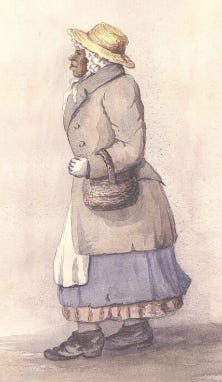
image from en.wikipedia.org/wiki/Rose_Fortune
There were, to be sure, some slaves who earned their freedom from fighting on the Patriot side. Some slaveowners “donated” their slaves to the Continental Army and they were emancipated. The First Regiment of Rhode Island was an integrated unit in which any slave was promised manumission for serving; that promise was only issued for four months, but it was honored for the 200 or so who served. However, the Patriot slaveholders, including Washington, were largely against freeing slaves or blacks joining the army at all.18 They didn’t want to lose their property. They didn’t want to arm black men or train them to fight, lest they start an uprising. The British didn’t own any slaves to lose, and an uprising against rebels would have been a welcome side effect.
After the Peace
Sir Henry Clinton had postwar plans for emancipation. He even wanted to give newly-freed slaves the lands the rebels would be forced to forfeit.19 Lord Dunmore had already enraged Virginians by threatening to free all their slaves.20 But as we know, the British surrendered and none of that came to be.
When British General Cornwallis surrendered at the Battle of Yorktown in 1781, he abandoned his black soldiers to their fate, return to slavery. The peace agreement, signed in September of 1782, stated that everything that had been stolen in war was to be returned.21 So Black Loyalists had good reason to fear they were next. American slavers traveled to New York City, where Loyalists, black and white, had taken refuge at British Army headquarters. The blacks living there witnessed slave owners kidnap their former slaves, or anyone, and bring them back to bondage. It was terrifying.
But when General Carleton arrived to manage the withdrawal, the conversation went something like this:
American General George Washington: “We won the war. We want all our property back that you took.”
British General Sir Guy Carleton: “Sure. Here it is.”
Washington: “You haven’t returned the slaves yet.”
Sir Guy: “They are not property. They are people. What’s more, they are either soldiers or employees of the British Army.”
Washington: “Whatever. We won the war. We want a list of runaway slaves and their masters and they better be returned.”
Sir Guy: “Ok, I’ll get you a list.”
As the Black Loyalists boarded the ships to Nova Scotia, British General Samuel Birch logged them in.
Washington: “I’m back and I want American slaves.”
Sir Guy: “I made these people a promise. I won’t go back on my word. If I did, I would bring dishonor on my name.”
Washington: “Promises made to slaves don’t count. You must be crazy.”
Washington tried several more times before he gave up and went away. The Black Loyalists named their new home Birchtown in honor of General Birch.
Sir Guy was determined not to repeat the debacle of Yorktown and to uphold what he felt was just. He compromised that compensation for freed slaves would be made to their former owners. Therefore, all blacks leaving New York with the British for other colonies were issued certificates proving their freedom. As the Black Loyalists boarded the ships to evacuate to liberty, General Birch catalogued names, descriptions, relationships, former masters, dates, and what work they did for the British.22
This log book became known as the Book of Negroes. It doesn’t just give their descendants more genealogical information than white Loyalists have. The Book provides them with the most colonial-era information on individual African-American ancestors that exists.
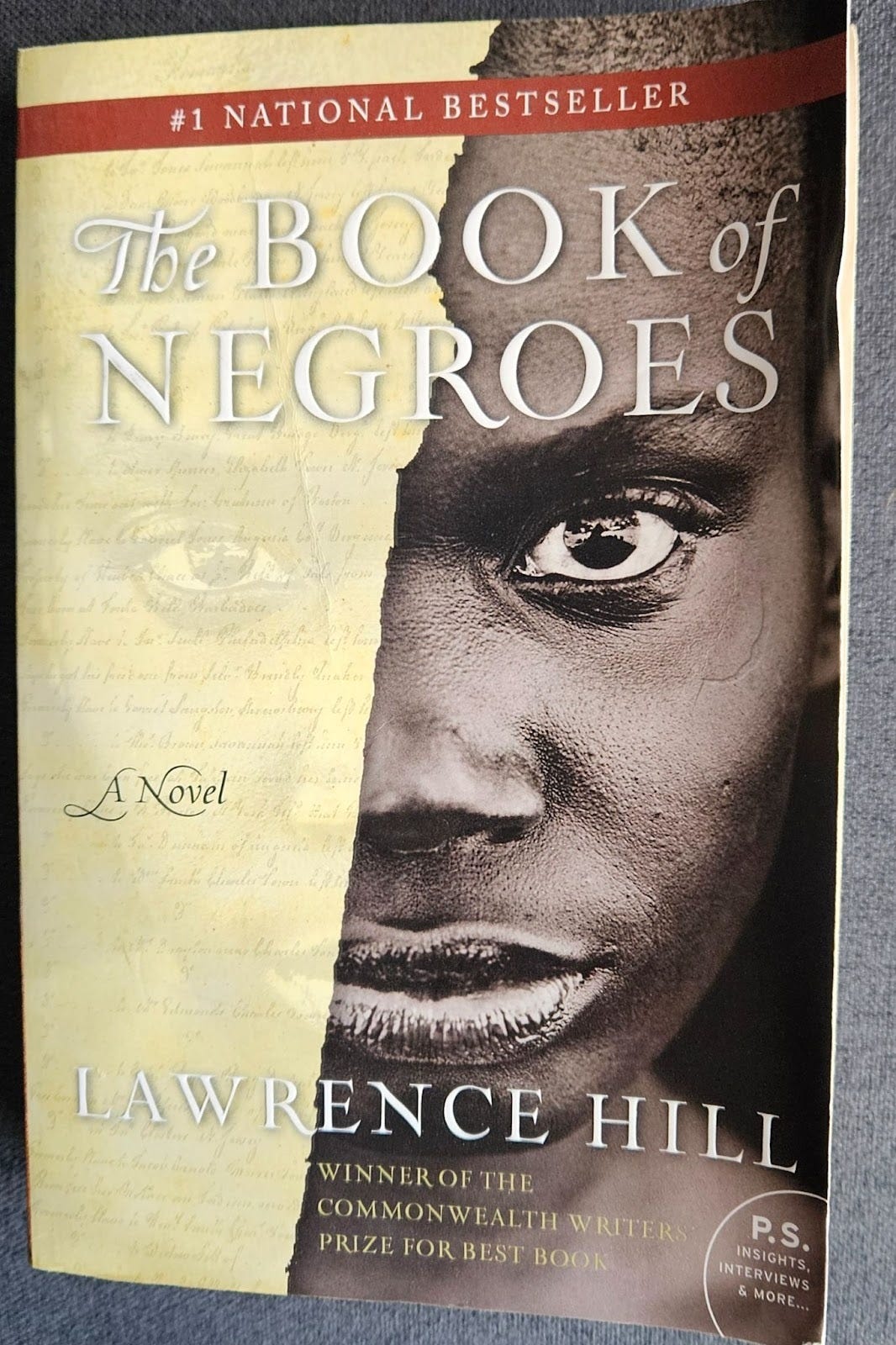
The Book of Negroes, an unforgettable masterpiece of a novel by Lawrence Hill, creates and follows a Black Loyalist’s life, https://www.lawrencehill.com/the-book-of-negroes
Officially granted free status, 3000 to 3500 blacks were evacuated to Nova Scotia, and others to British ports in England and Florida, over the spring and summer of 1783. The first, the L’Abondance, sailed on July 31, 1783 for Shelburne, Nova Scotia, with a crew of 81: seamen, a gunner, a carpenter, a carpenter’s mate, a cook, a clerk, and a surgeon. The Black Loyalists numbered 179 men, 147 women, and 84 children.23
Shelburne was a massive exercise in what not to do when you are building a new city. The plan was flawed from the start. Beginning a city without an underlying industry was unworkable. Expecting city-dwellers to create something out of the wilderness was unrealistic. Thinking that disbanded soldiers would be productive without clear direction led to disaster.
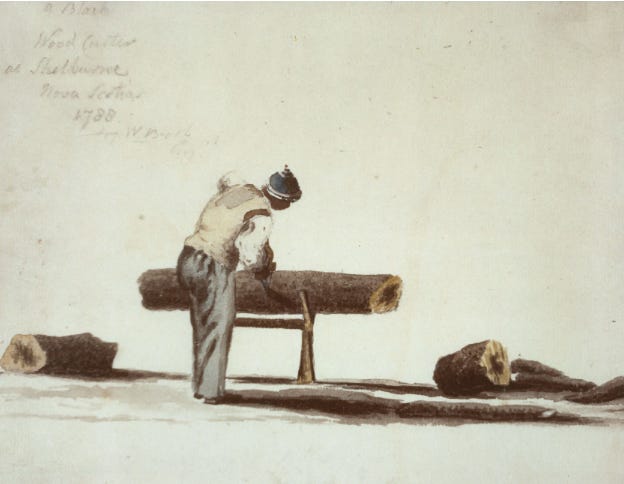
This 1788 watercolour sketch by Captain William Booth, Corps of Engineers, is the earliest known image of an African Nova Scotian. https://archives.novascotia.ca/africanns/archives/?ID=39
The 1500 or so Black Loyalists in Shelburne had plenty of work in the early boom months, when ships were pouring in and everyone expected, however anxiously, quick land grants. They earned good money as builders, servants, and porters unloading ships and delivering goods to new houses. Preacher David George was so compelling, blacks had a growing integrated church and their own school.24 But when the ships stopped coming, the settlers’ money was spent, the government rations had run out, and the land grants still hadn’t been completed, all that ended.
The blacks largely lived in a section on the north end of the harbor, unsurprisingly called Blacktown. Without shelter in the terribly cold winters, they built themselves pit houses. Crude shelters dug into the ground, they were meant to be temporary, but when the land grants didn’t come thru, Black Loyalists lived in them at least until 1792.25
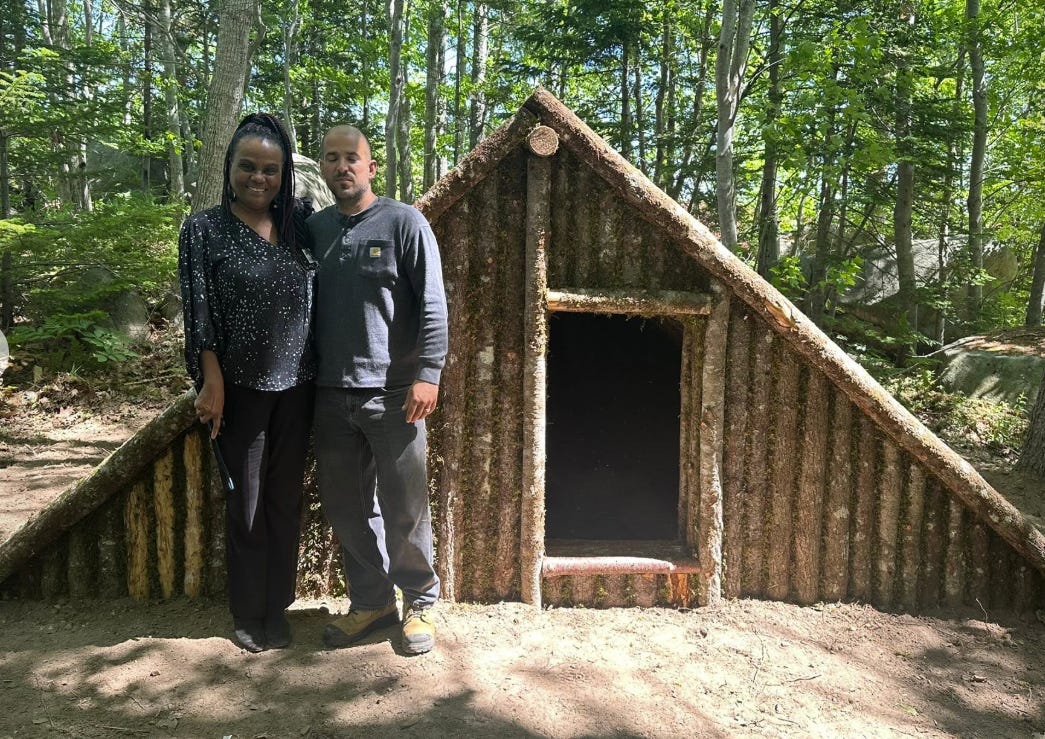
replica of a pit house, photo from https://www.facebook.com/BlackLoyalistHeritageCentre, June 17 2026
Birchtown, intended for the Black Loyalists, was surveyed and laid out early, in August 1783. It is however, among the rockiest and poorest soil in the rocky poor soil of Shelburne. Surveyor Marston even wondered why the Black Pioneer regiment’s Colonel Stephen Blucke approved of it.26 I’m sure, if it were me, I would have agreed to accept any plot in order to become a landowner. Some blacks immediately set up residence there, while others lived in town closer to work.
In June 1784, North America’s first race riot was perpetrated by angry disbanded soldiers. Their lack of income or land grants was blamed on working blacks. After driving blacks out of Shelburne and destroying Blacktown, they continued their attacks in Birchtown, where the displaced blacks had fled. The governor sent troops to stop the ten days of rioting. After that, all hope of Black Loyalists getting their land grants was over.27
Conditions were so bad that 1200 people took up a British abolitionist society’s offer to settle a new country in Sierra Leone, Africa.28
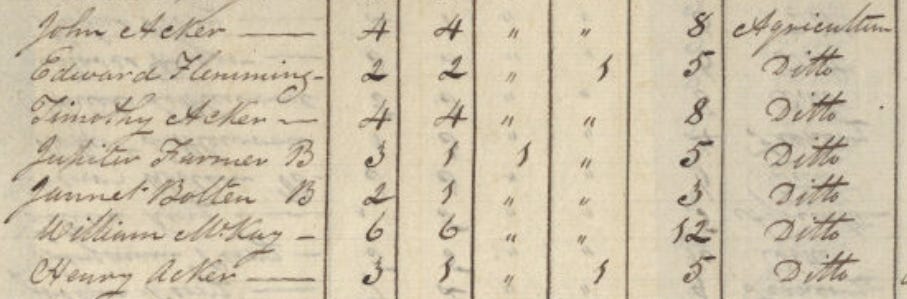
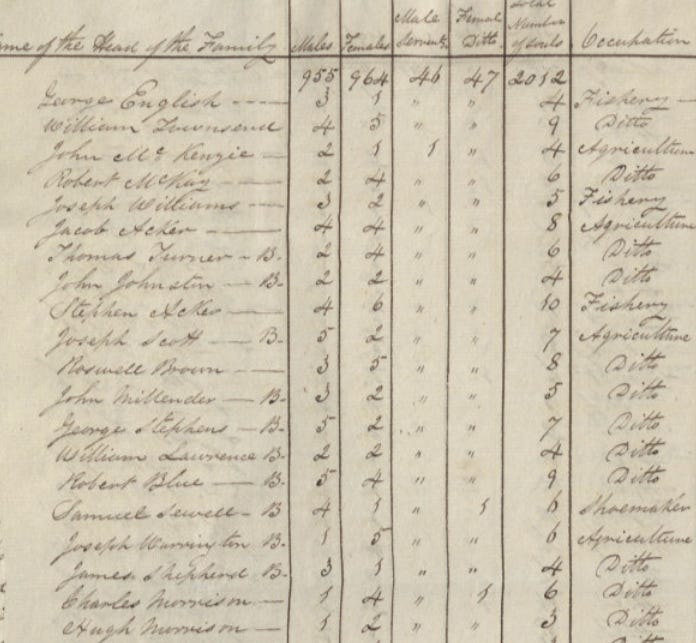
This 1827 census above shows an integrated community, with my ancestors, the Ackers, and their black neighbors, Jupiter Farmer, Jannet Bolten, Thomas Turner, John Johnston, Joseph Scott, John Millender, George Stephens, William Lawrence, Robert Blue, Samuel Sewell, Joseph Warrington, and James Shepherd.
All the black heads of household were employed in agriculture except Samuel Sewell, a shoemaker. Except for one fisherman, my family were also farmers.29
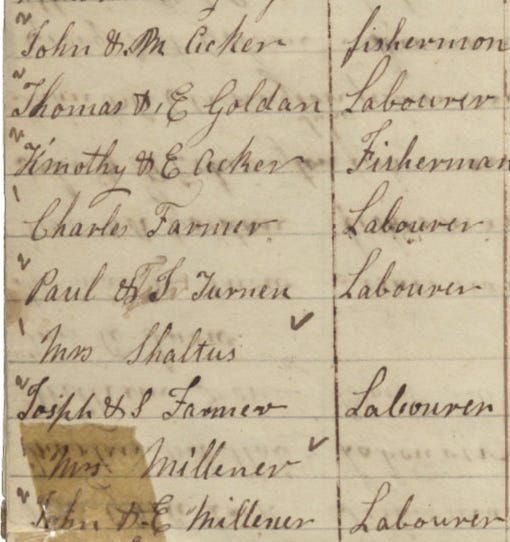
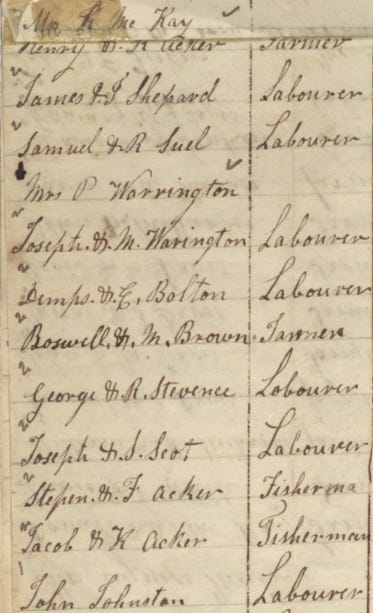
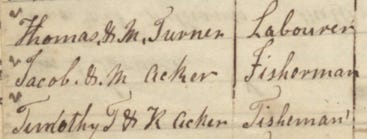
By 1838, Jupiter Farmer’s family has extended to Charles Farmer, Paul and his wife T. Farmer, and Joseph and his wife S. Farmer. Demps and his wife E. Bolton live where Jannet Bolten was. Thomas Turner has given way to Paul and his wife J. Turner. John Johnston is living alone. Joseph and Mrs. S. Scot are still there. The Millender family is now Mrs. Millener and John with his wife S. Millener. George and R. Stevence are still there. Samuel and Mrs. R. Suel are now next to Mrs. P. Warrington and Joseph and Mrs. M. Warrington. James and his wife J. Shepard complete the neighborhood.
All are labourers; my ancestors are fishermen. My households have expanded from five to eight, including Mrs. Shaltus. Altho William Lawrence and Robert Blue are gone, (the Blue family must have remained without heading a household, as they reappear twenty years later), their other black neighbor households have expanded from twelve to fourteen.30
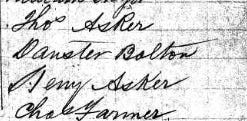
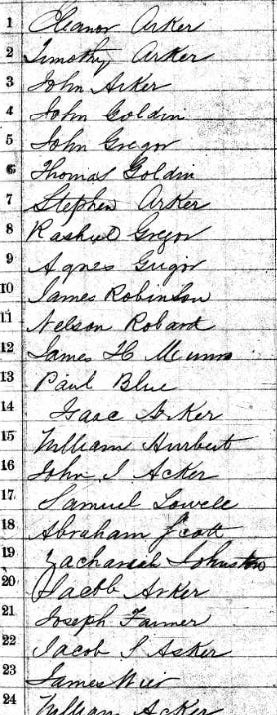
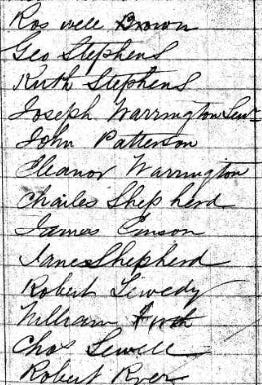
By 1861, there are now fourteen black households: Danster Bolton, Charles Farmer, Paul Blue, Samuel Sewell, Abraham Scott, Zachariah Johnston, Joseph Farmer, George Stephens, Ruth Stephens, Joseph Warrington Senior, Eleanor Warrington, Charles Shepherd, James Shepherd, and Charles Sewell. My Acker households have expanded to eleven.31
In 1881, the Birchtown census gave individual names and ethnic origins. Among 525 people, the majority of whom are related to me, 66 Africans are interspersed among the Germans, Scotch, and Irish. The names Steavens, Scott, Farmer, Sheppherd, and Warrington are well represented. Almost every man in Birchtown is a fisherman or farmer.32
At the 1921 census in Birchtown, there were 43 households, all but one of whom owned their homes. My family made up 20 households. There were 9 households with “Negro” listed as their ethnic group, with house size between 2 and 5 rooms. The households of “English” descent were sized between 2 and 9 rooms.33
In 1931, the most recent census available, not much had changed. Of 42 households, 23 held my family members and 7 households were made up of people of “Negro” descent. Everyone owned their own home, altho the houses of descendants of Black Loyalists were valued at $200 to $300 compared to the $600 to $1000 houses of residents of “English” descent.34
Sometime between 1794, when Ester and John Acker paid taxes in Shelburne town,35 and the 1827 census, when six of their children managed households in Birchtown,36 my ancestors moved in. I have not found any deeds or land grants; I hope they didn’t steal it.
The majestic and immersive Black Loyalist Heritage Centre in Birchtown taught me all this information. A curator was incredulous that, living in Virginia, I had never heard of the Virginia Proclamation. I was incredulous that my African-American colleagues, teaching American history in a majority-minority school district in Virginia, were unaware of it. Once I shared what I had learned, they saw what I saw….
Blacks in Birchtown, while poor, discriminated against, landless, starving, and attacked, were free, educated, connected with their families, and documented in detail with these families. At the same time, blacks in Virginia were treated like livestock. It was illegal to teach them to read. They could be maimed, killed, and sold away from their families forever. Their only documentation was as property, not people.
The Book of Negroes personifies the transition from one reality into another. Intended to be just another bureaucratic ledger of merchandise, the kind that erased people, it instead became a great act of preservation.
The ideal of the Revolutionary War was freedom. It came for many blacks living in bondage. Just not in the way we think.
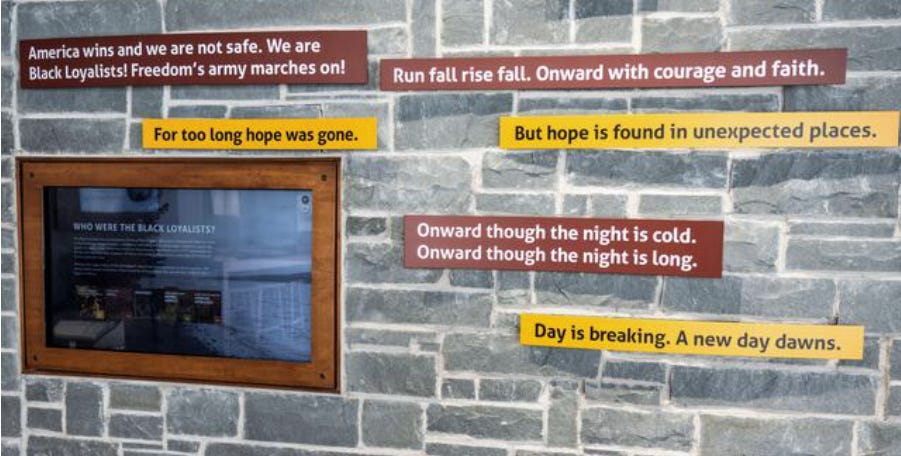
inside the Black Loyalist Heritage Centre, Birchtown, photo from alamy.com
Suggested further reading:
An excellent detailed source is https://encyclopediavirginia.org/entries/lord-dunmores-ethiopian-regiment/.
A detailed source for Black Loyalists in New York is https://www.gothamcenter.org/blog/black-loyalists-evaculation-zy4la
A primary source for the Royal Ethiopian regiment is https://www.royalprovincial.com/military/rhist/ethiopian/ethreports.htm.
A very detailed text is https://blackloyalist.com/cdc/index.htm.
I used Claude.ai to help me edit for errors.
Footnotes:
History and Social Science Standards of Learning for Virginia Public Schools, April 2023, Board of Education, Commonwealth of Virginia
https://avalon.law.yale.edu/18th_century/patrick.asp
https://en.wikipedia.org/wiki/Slave_trade_in_the_United_States - price of adult male in Richmond in 1849
https://www.gilderlehrman.org/history-resources/spotlight-primary-source/lord-dunmores-proclamation-1775
https://encyclopediavirginia.org/entries/lord-dunmores-ethiopian-regiment/
lord-dunmores-ethiopian-regiment/
lord-dunmores-ethiopian-regiment/
https://en.wikipedia.org/wiki/Black_Company_of_Pioneers
www.gilderlehrman.org/
https://www.amrevmuseum.org/black-founders-big-idea-2-black-soldiers-and-sailors-in-the-revolutionary-war
https://www.philipsemanorhall.com/blog/the-philipsburg-proclamation
philipsemanorhall.com/the-philipsburg-proclamation
www.gilderlehrman.org/
https://www.battlefields.org/learn/biographies/colonel-tye
https://www.history.ox.ac.uk/boston-king-and-the-black-loyalists-of-the-american-revolution-0
https://american-revolution-experience.battlefields.org/people/harry-washington#washington-modern-day-legacy
https://annapolisheritagesociety.com/community-history/notable-personalities-past/rose-fortune-privileged-character/
DiSanto, Victor J. from: Hufeland, Westchester County During the Revolution, 324, 379; John Lockwood Romer, Historical Sketches of the Romer, Van Tassell, and Allied Families, and Tales of the Neutral Ground (Buffalo: W.C. Kay Publishing Company, 1917), 46-47, 53 and 93; Lincoln Diamont, Yankee Doodle Days (Fleishmanns: Purple Mountain Press, 1996), 116-117; Robert Howe to Washington, July 8, 1780, founders.archives.gov/documents/Washington/03-27-02-0028; Barnett Schecter, The Battle for New York (New York: Walker and Company, 2002), 350; Sy Shepard, Patriot vs. Loyalist (New York: Osprey Publishing, 2022), 34.
https://encyclopediavirginia.org/entries/lord-dunmores-proclamation/
https://blackloyalist.com/cdc/index.htm
blackloyalist.com/cdc
blackloyalist.com/cdc
https://uelac.ca/wp-content/uploads/2025/08/Loyalists-Evacuation-Vessels-Stephen-Davidson-2025.pdf
blackloyalist.com/cdc
blackloyalist.com/cdc
https://en.wikipedia.org/wiki/Black_Company_of_Pioneers
blackloyalist.com/cdc
blackloyalist.com/cdc
Census Returns, 1827, archives.novascotia.ca
Census Returns, 1838, archives.novascotia.ca
1861 census of Canada for Isaac Acker, Shelburne, NS, Ancestry.com
1881 census of Canada for Isaac Acker, West Township of Shelburne, NS, Ancestry.com
1921 census of Canada for Isaac Acker, Birchtown, NS, Ancestry.com
1921 census of Canada for Isaac Acker, Birchtown, NS, Ancestry.com
Poll Tax Records, 1791-1795, archives.novascotia.ca
Census Returns, 1827, archives.novascotia.ca
Comments
Post a Comment