As I wrote, I heard the voices of my grandmother and her sisters whenever Sarah spoke.
(see Rushton Pedigree Chart, Sarah Hall & Jeremiah Rushton Descendant Chart, Sarah Hall Rushton, the Cordwainer's Wife ~ Chapter One, Revolutionary Cowboy in New York ~ Jeremiah Rushton Stole for King and Country Parts One and Two)
In Chapter One, we met Sarah Rushton on her land grant in Westchester, Nova Scotia, walking her favorite path with her daughter Elizabeth and grandchildren. Sarah, her husband Jeremiah, and his family had run a successful cordwaining business in New York City during the Revolutionary War, earning good silver money serving thousands of people jammed into a city under occupation. When peace came and Jeremiah's regiment was disbanded, the Loyalist family faced exile. Elizabeth, fretting over her own husband's plans to move the family to Upper Canada, challenged her mother: it wasn't Sarah's choice to leave New York, she said. Danger forced her.
The Story of the Soldier’s Wife….a fictional look
“But how can I decide, Mama?” Elizabeth begged. “When did you know it was the right time to leave? And how did you know what to bring? What to leave behind?”
Her voice dropped to a whisper Sarah barely heard. “How can you even tell?”
“Well. We didn’t have a choice,” Sarah stated flatly. “Not the time, the place, even which ship. As to what to bring or leave behind, there wasn’t much to decide there either. We brought everything we could carry. It’s simpler, really, when you have no choice.”
She held Elizabeth’s face in her hands. “It’s harder for you.”
Elizabeth pulled away. “I don’t see how.”
William appeared from behind Sarah. “Tell us, Grannie. How did you leave New York?”
Sarah nearly tripped. “Have you been behind us this whole time?”
“Yes,” William nodded eagerly while his grandmother regained her footing. “I want to hear the story.”
“Well, there were all of us,” Sarah began. “You count how many. Your grampa and me, his parents, and all his brothers and sisters. Uncle Peter and Aunt Catherine had children, and Uncle John was married. Cousin William Coon. Grampa and I had your Uncle Abraham.1 He was a baby just starting to walk.”
“Ten people!” Eddie held up both hands.
“Sixteen,” William corrected him.
“I don’t have that many fingers,” Eddie explained.
“We lived in the city.” Sarah considered, then swept her arms toward the distant forest. “As many trees as we have here, that’s how many people are in the city. Every one of them talking about something different.”
The children’s heads followed Sarah’s arms, mouths forming an O. Even Elizabeth surveyed the landscape, imagining something she had never seen.
“We had a shop as big as your house, where we made shoes.”
William nodded. He had watched his grandfather make him several pairs as his feet grew.
“All those people came in and out of our shop every day to buy shoes. That’s where we got our news, or Great-Grampa read Rivington’s Gazette.”
“What’s that?” William wanted to know.
“It’s like a small book, not many pages,” Elizabeth explained. “It is printed once a week or more, and every time it says something different. Whatever happened new that week was printed on the pages. People could buy one cheap.”
“A dollar and a half a year,” Sarah agreed. “Great-Grampa got them twice a week, as soon as they came out.2 He liked to know what was happening. Some people said the war was likely over, but others said it would keep going. It sure seemed like it would keep going. All the soldiers were still there in the city, and your grampa was off fighting. We hardly ever saw him, or got word even.
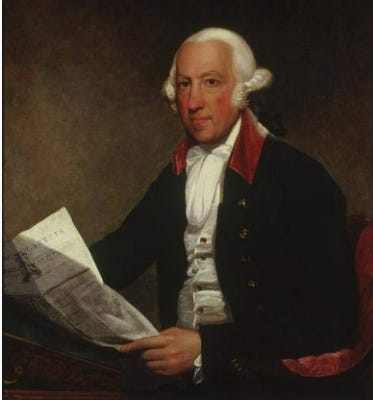
James Rivington holding a copy of his Gazette3
“It all changed in March. The news came that the peace treaty had been signed in Paris.4 The rebels had won! It seemed mad, but England just gave up. The British troops were going to leave, which was all right, but we didn’t know what would happen to us who were for the king.
“When Great-Grampa read the peace treaty, it just said the British hoped the rebels would treat the Loyalists, that was us, fairly. It didn’t say they had to. And because Grampa had fought in the war, we were afraid he’d be hanged.”
William’s mouth fell open. “Like a bad man?”
“What’s hanged?” Eddie elbowed William. “Like the washing?”
“No. Sshh,” William hissed impatiently at the same time Elizabeth told the little boy “Yes.”
“What happened?” William breathed. “Did they catch him?”
“No,” Sarah went on. “His leader, Colonel DeLancey, escaped to England in April and all the soldiers came home. We had until winter to get out of the city.”
“The good thing about your grampa being a soldier with the Westchester Refugees, we made arrangements as a group. That spring they told us we would go to Nova Scotia. We thought we had a really strong claim to a land grant because he actually fought for the king, not just helped.”
“What’s a land grant?” William wondered.
“King George gave everybody who was loyal to him a piece of land in one of his colonies. But then we heard that the rich people were taking it all, and we were afraid we wouldn’t get any. So Papa signed a letter to General Sir Guy Carleton telling him we needed land, too. It was a really frightening time…we were afraid we might get left in New York at the Rebels’ mercy, or else be forced to leave with nowhere to go.
But Sir Guy came thru. I don’t know if it was the letter or not, but he made sure we got on one of the early ships.”
“What was it like on the ship? Was it big?” Eddie wanted to know.
“It sure was. But so packed with people and their belongings, it was hard to move about. Chests and barrels and sacks everywhere. We hung quilts up between the families to give ourselves a little privacy. It was windy and cold, but we tried not to stay belowdecks too much, because we were all seasick! We were on the ship five days.”
“What’s seasick?” Eddie asked.
“When you throw up,” Elizabeth told him. All three children grimaced.
“You were all sick for five days, Grannie?” Eddie, concerned, took Sarah’s hand.
“Most of us were. We were so happy to get off that ship, I can tell you.”
“Why were you sick?” William wanted to know.
“You know when Papa gives you a piggyback ride? How you jiggle up and down?”
William nodded. “But that’s fun!”
“Yes, well, that’s what the ocean does. If Papa did that for five days straight, and you couldn’t get off, you’d be sick.”
While the children considered that possibility, Elizabeth pressed her concerns. “What did you bring to your new country? What did you decide to leave?”
“Good thing we were a big family, with strong men. Almost all of us were grown. And each family could bring something that we all could share when we got here.
“We had made good money in the city, shoeing all those people. We only took some in kind; most people paid in British coin, real silver. As luck would have it, we were some of the earliest to leave. So there were still things to buy, the prices not too dear. And folks were still trying to buy shoes even after the shop was all packed up!
“We had a lot of coin, but that made us scared it would be stolen. So we divided it up among all the grown people, plus the chests. Hid it with the food, the candles, in the pillows. I don’t think we lost any.
“The most important thing, of course, was food.”
“Food to eat!” yelled Lucy.
“Yes.” Sarah picked up the toddler and kissed her. “As much as we could buy in the city. The ship gave us meals at sea, but for when we landed, we brought biscuits, cheese, butter, salt pork, and pickles. A cask of salt, one of sugar, and one of tea.”
“I like bikkit. And butter,” Lucy announced. “And mick.”
“Did you have milk, Grannie?” Eddie noted what his grandmother had left out.
“No,” Sarah replied, “it would have soured.”
“What did you bring for the winter? Did you think it would last till spring?” Elizabeth asked.
“Well, we hoped so, and aught to start crops with…seed potatoes, turnips, cabbage, onions, carrots, peas, beans, parsnips. Wheat and rye, to make bread with and to sow next year. And of course, dried herbs and medicines.”
At the word medicine, Lucy wriggled down and ran off. Her brothers followed.
“Next, we brought what was light enough to carry. Chests with all our clothes, all our bedding and linens.
“What was precious to us, we kept on us…the Family Bible, the family register, Great-Grampa’s books. He brought his silver watch and his silver shoe buckles.
“Is that the watch he left Papa in his will? That Papa winds every day, and keeps polished?” Elizabeth asked.
“Yes,” Sarah nodded. “The very best that he owned. He left his silver buckles to Uncle Peter. You haven’t seen those, I don’t think.” Elizabeth shook her head. “We brought all the silver we had,” Sarah went on. “Spoons and forks, the pewter dishes. If we had to, we could sell it.
“What we knew we couldn’t get in the woods, we took with us…cards to play, a cribbage board.5 Toys for the children.
“Then, the tools. As many shoemaking tools, lasts, leather, and extra shoes as we could fit in the chest, along with the sewing needles, thread, thimbles, scissors, and pins. Kitchenware…knives, cups, plates, grater, sieve, ladles, small earthenware bowls and crocks. Buckets. And as many candles and soap as we could fit in the trunk…who knew where we could buy any, and we wanted to go as long as we could before we had to make some.
“We had to leave the furniture behind…too big and heavy. And the pots too...each family could only carry one.”
The children, bored, had moved on to leapfrog. With them out of earshot, Sarah faced Elizabeth. “You’ll not have as many people to help you, or to carry as many goods. But traveling by wagon, you can bring your big spinning wheel, and maybe your bedstead.”
“I don’t know how many plan to go,” Elizabeth replied. “Samuel’s parents will be with us. But there may be a goodly number of families who want to trade their poor land here for what’s said to be farm country.”
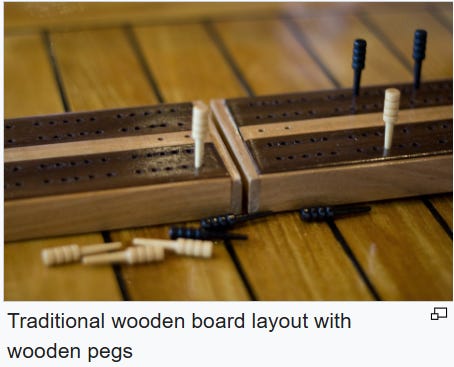
A cribbage board, https://en.wikipedia.org/wiki/Cribbage
A Chronicle of a Soldier’s Wife…a factual account
Sarah and Jeremiah Rushton boarded the Thetis with their baby Abraham in June 1783,6 leaving wartorn New York City for the unknown. The Westchester Refugees who settled the Cobequid Grant were all on that ship; for Sarah, the comfort of traveling with her in-laws could very well have been tempered with the pain of leaving her birth family behind. Five Rushton men were granted land in Nova Scotia: John, his sons Jeremiah and Peter, and his wife Mary’s kinsman William Coon; each got 500 acres in what they christened Westchester. John Rushton Junior received 200 acres in Ramsheg, now called Wallace.7 In total, 224 Westchester men received land on the Cobequid and Ramsheg grants.8
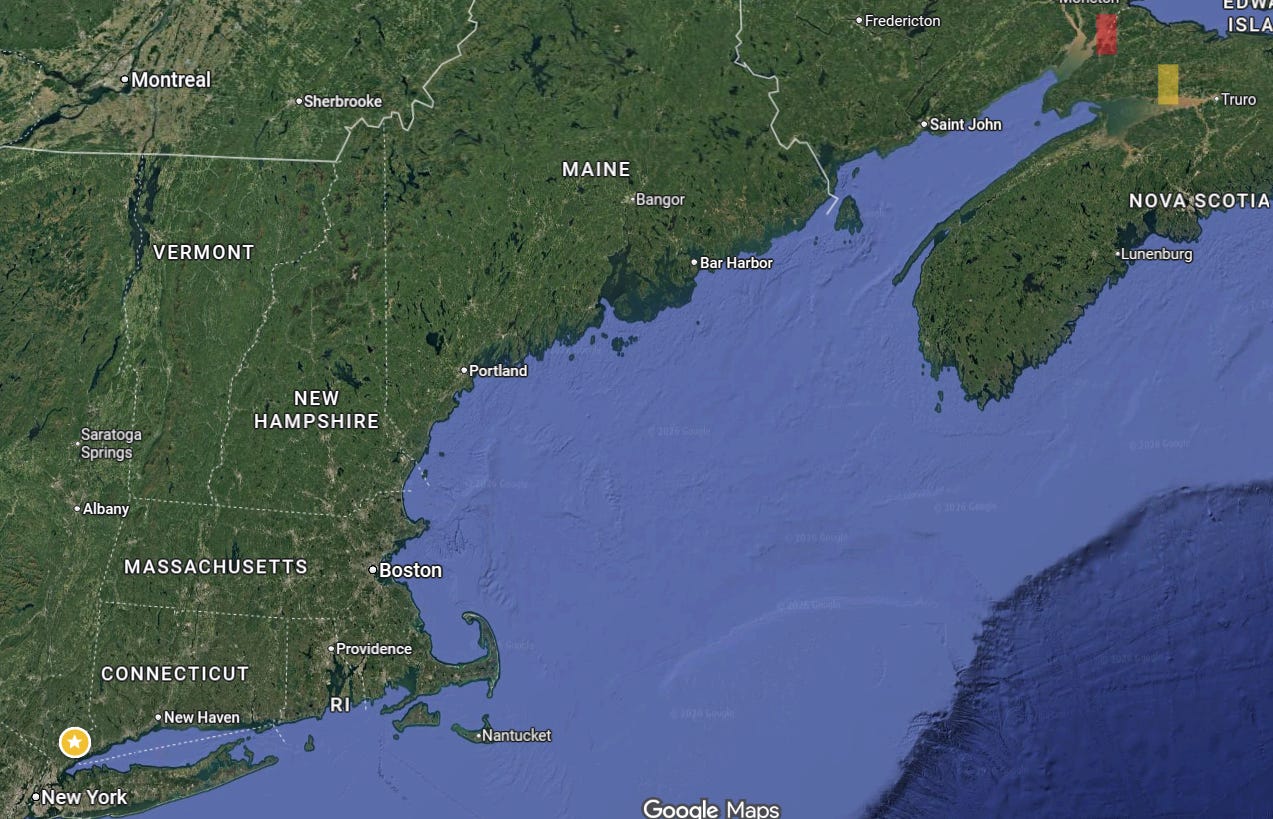
Google Map image of the sea route Loyalists took from New York City, shown by white New York dot, to their destination. Many landed at Saint John. The Rushtons went to Fort Cumberland, shown as red rectangle, and finally settled in Westchester, Nova Scotia, shown as yellow rectangle. Their original home of Westchester, New York is shown with star.
It was necessary for Loyalists to flee the new United States to avoid persecution and violence. While some entertained the idea that they would be able to return home and continue as before, news of whippings, tar-and-featherings, and imprisonments spread. A soldier such as Jeremiah would certainly not have been forgiven. Therefore, as the news that the British Army would withdraw from an independent America slowly made its way across the ocean, Loyalists from every colony fled to New York City.
General Sir Guy Carleton had been assigned to manage the withdrawal, and he worked tirelessly from Spring 1783 until November to evacuate some 30,000 troops and 40,000 Loyalists by ship.9 Carleton used both naval ships and hired merchant vessels to transport the evacuees. Loyalists were largely organized into companies headed by captains, usually by affiliation such as regiment or home county.10 The Westchester Refugees fit both categories. Companies were assigned destinations, ships, and times of departure, possibly in that order.
Even so, the Rushtons’ group worried. At some point, Jeremiah Rushton signed an undated petition along with over 500 other New York Loyalists. It related that the writers had just learned 55 other Loyalists had already petitioned Carleton for 275,000 acres at an average of 5,000 acres each, and had quietly dispatched agents ahead to survey the unlocated lands and select the “most fertile Spots and desirable situations.” The ordinary signatories feared that by the time they arrived, the best land would be locked up by a small group of wealthier, better-connected Loyalists, leaving them with, as they put it, “barren or remote lands,” or in the humiliating position of becoming tenants to men “they consider(ed) their superiors in nothing but deeper Art and keener Policy.”11
The writers of the memorial asked that either everyone be put on equal footing after a fair inquiry into respective losses and services, or, if the first applicants were found more deserving, that the large grants be postponed until the ordinary settlers had taken up their smaller allotments.
Either the memorial had an effect or the Westchester group had always had a strong claim, because Sarah and her family were fortunate enough to board the second tranche of transport. This fleet headed for Fort Cumberland, in what was then Nova Scotia but is now New Brunswick. The Thetis was one of two brigs along with a frigate and thirteen other ships to shuttle passengers there in June.12
A brig was a two-masted square-sailed vessel popular in the late 1700s. It was a fast cargo ship,13 which made it ideal for transporting as many passengers carrying belongings in as short a period of time as possible. The Rushtons were lucky to make it onto the Thetis. Their passage of five days was quite short compared to the two weeks other ships took. The hold built for cargo meant they were able to take many of their possessions with them.
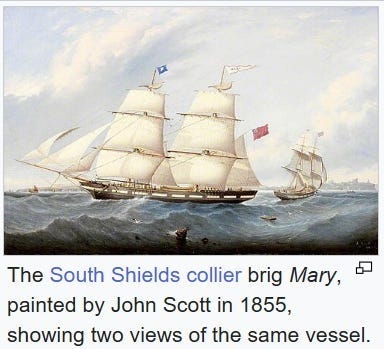
Wikipedia, Brig14
Consider what you would take with you if you were forced to leave your home with a few weeks’ notice with little information on your destination. The constraints on your luggage are size and weight. It’s just about the same question as, “What would you take with you to a deserted island?”
Out of pure necessity for survival, food and medicine are the top concerns. Food needs to be nutritious and both need to be non-perishable. Hence, grain, butter, cheese, dried meat, pickles,15 root vegetables, dried herbs, salt, sugar, tea. Livestock was not allowed, altho the Rushtons would probably not have had any as city-dwellers.
Tools needed for survival would be those for hunting, sewing, cooking, building, and farming, altho they must be fairly small and light…no spinning wheels, plows, or cauldrons.
The next question to consider would be, “What is valuable to you?” What could Sarah not bear to part with? The items that John Rushton left his heirs when he died in 1799 were almost certainly brought from New York…his silver watch, silver buckles, Bible, family register, and shoemaker’s tools.16
The next decision would be value per pound of weight. Clothing and bedding, which took hours of labor over years to create, would be at the top of the list. Silver coins and items such as utensils or jewelry would also have great value.
Looking to the future, seed and seed vegetables would be necessities.
If there was room, morale boosters like cards, games, and books would be added. Last, items not strictly necessary but useful to make life easier….supplies of candles and soap, difficult and time-consuming to make but vital to have. Extra tools of all kinds.
However, the logistics of choosing, packing, and transporting depended on each individual family’s situation. What items did they already own? How much time did they have to prepare? How much room were they allotted on their given ship? How much money did they have to purchase new items upon arrival?
Stay tuned for Chapter Three.
Cumberland County Genealogies, Westchester Township Book
https://allthingsliberty.com/2014/03/james-rivington-kings-printer-patriot-spy/
https://en.wikipedia.org/wiki/James_Rivington
https://www.worldhistory.org/timeline/Treaty_of_Paris_of_1783/
When I was a child, all my elderly relatives had cribbage boards in their houses.
Vincent, G. R. 46 Acres, 5 Hoggs, and a Family…North Cumberland Historical Society, Pugwash, NS, 1986
Gilroy, Marion, compiled by, Loyalists and Land Settlement in Nova Scotia, Cumberland County Grants, Public Archives of Nova Scotia.
Gilroy, Loyalists and Land Grants, Cumberland County, pp. 38-42
https://uelac.ca/wp-content/uploads/2025/08/Loyalists-Evacuation-Vessels-Stephen-Davidson-2025.pdf
https://uelac.ca/wp-content/uploads/2025/08/Loyalists-Evacuation-Vessels-Stephen-Davidson-2025.pdf
Memorial of New York Loyalists. Entered by Benjamin Rand, Sept. 26, 1890, New York Biographical and Genealogical Record
https://uelac.ca/wp-content/uploads/2025/08/Loyalists-Evacuation-Vessels-Stephen-Davidson-2025.pdf
https://en.wikipedia.org/wiki/Brig
https://en.wikipedia.org/wiki/Brig
This is a fascinating first-hand account. Babineau, Annabelle, https://loyalist.lib.unb.ca/atlantic-loyalist-connections/loyalist-lowdown-hannah-ingraham-childs-perspective
Items listed in will of John Rushton, proved 10 July 1800, Probate Records Old Wills: Cumberland. Probate Indexes 1789–1945, Familysearch
Comments
Post a Comment