What is an armed boatman? A man, with a boat, and weapons? Did he row around the coast and then all of a sudden, stand up and shoot?
Yes. He pretty much did.
My 4th great-grandfather William Rowland was a private in the Loyalist Company of Armed Boatmen in the Revolutionary War.1
Whaleboat War
Back then, everybody knew what “armed boats” were, the official name for the whaleboats used by privateers, another official name meaning a legal pirate.
A whaleboat was a narrow open rowboat, 30 to 36 feet long, with pointed bow and stern and 8 to 10 oars to be rowed by 8 to 10 men. A boat may have had a short removable mast; some had small cannons, but otherwise the armed part referred to the bayonets, swords, and muskets carried by the crew.2
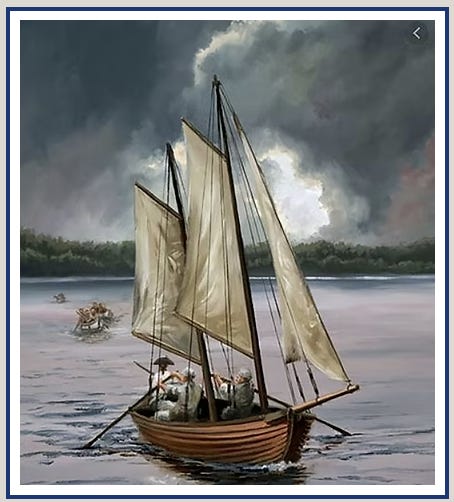
Whaleboats of privateers in the Revolution, https://www.monmouthhistory.org/250/the-bold-privateering-of-adam-hyler
Rebel whaleboats had a Mate as the helmsman and eight privates as the crew, which rotated. If the Loyalist boats were similarly crewed, the size of the Armed Boatmen Company means it had about eight boats.3
New York City was the British Army’s main base of operations for most of the Revolutionary War. Loyalists from all over the colonies sought refuge there. Flowing west from the city, Long Island, rural with small towns, provided the city with food and other goods.4 Long Islanders held a mix of opinions. The closer to New York City, the more prevalent was allegiance to the King, all the way to Hempstead. On the eastern end, towns that had been settled by New Englanders aligned with rebellious Connecticut. Connecticut lay across the Long Island Sound to the north. On a clear day, you can see across. What did it mean that coast-dwellers, who had easy access to boats and knowledge of the water, were able to see enemy land?
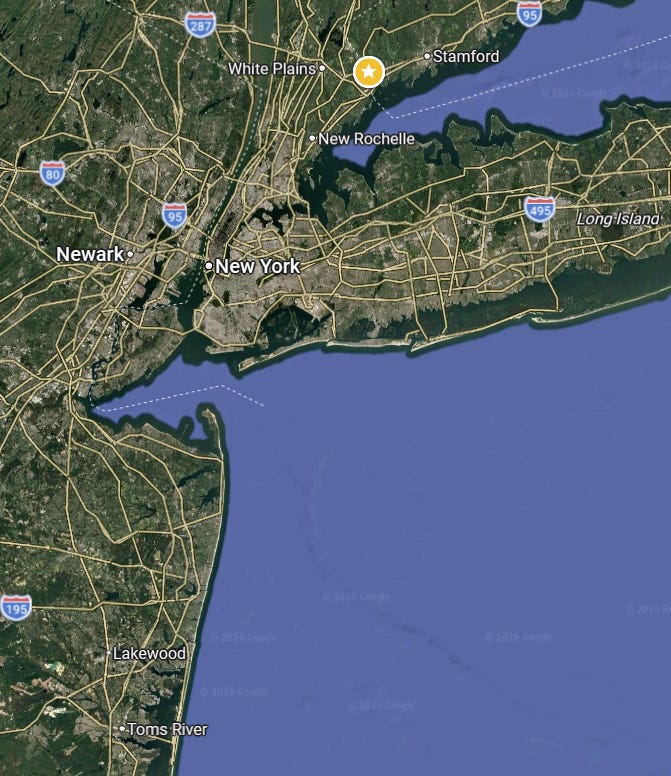
current map, with Stamford Connecticut on the north coast of the Long Island Sound; Long Island and Manhattan, New York; Newark New Jersey across New York Harbor from Manhattan; and Lakewood and Toms River New Jersey along the Jersey Shore, Google Maps
One thing it meant was that the famous Culper’s spy ring operated by sending messages across the Sound in whaleboats. It also meant smuggling because trade between Connecticut and Long Island was mostly illegal.5 And it meant Patriots who had fled to Connecticut often wanted to risk recovering their belongings. Then, of course, it meant thieves.
Another thing it meant was that local men in whaleboats were constantly raiding the other side.
The other side of the Sound.
The other side of the war.
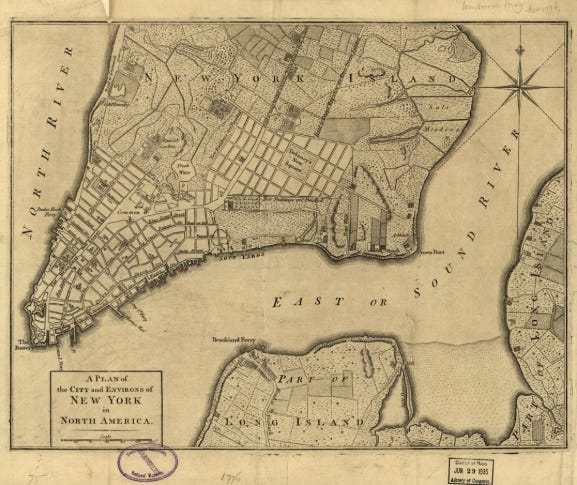
A British war map, with Manhattan or New York Island, the North or Hudson River on the west, the East or Sound River as the strait joining New York Harbor with Long Island Sound, and Long Island on the south and east
On the other side of New York City was the Jersey shore. Similar other-side dynamics went on there too. The difference was that New Jersey saw more bloodshed…hand-to-hand combat…houses burnt to ashes…personal retaliation…or, homes personally spared. Because New Jersey was more internally divided. One-third Patriots, one-third Loyalists, one-third pacifist Quakers, New Jersey bred personal feuds.6
Throughout the Revolution in what was known as the Whaleboat War, raiders attacked locations on the mainland surrounding New York City, British commercial ships, and, of course, each other. Supply deliveries were interrupted, warehouses destroyed, and goods seized. Privateers brought their prizes home, where they were legally supposed to sell them and divide the profits between their financial backers and their government.7 I don’t know how closely that process was followed.
The Armed Boatmen
By 1781, the British side was losing too many whaleboat wars. Two of three battalions supposed to protect New York City’s port had been sent south. Sir Henry Clinton, Commander in Chief of the British Army, lodged complaints, but the Navy didn’t send enough ships to stop the raids.8 So Clinton, rather ingeniously I think, took matters into his own hands.
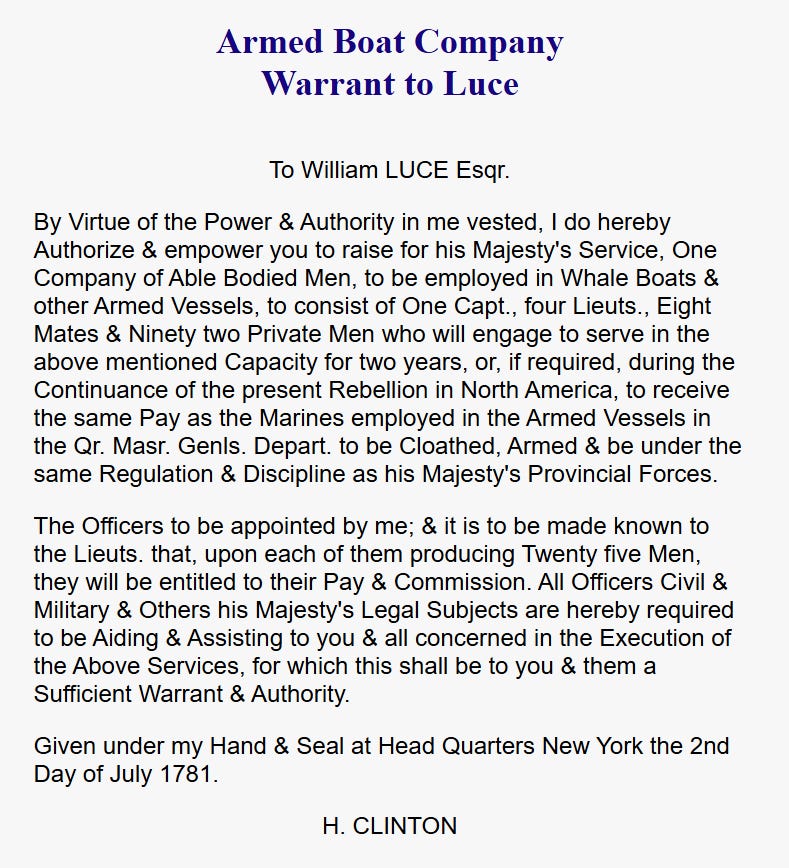
Warrant of Armed Boat Company, https://royalprovincial.com/military/rhist/abc/abcform.htm
He authorized William Luce, a New Jersey Loyalist, to raise a company of Armed Boatmen. The Boatmen were part of the Army. They were to be employed in whaleboats and other armed vessels. They were to receive the same pay as the Marines employed in the Quartermaster’s armed vessels. They were to be clothed and armed and operate under the same discipline and regulation as His Majesty’s Provincial Forces. And they were to serve for two years or the continuance of the present rebellion in North America.9
Captain Luce raised 92 able-bodied privates, 8 mates, and 4 lieutenants, as instructed. Commander Dongen recruited 125 more, mainly from New Jersey, including many black men.10 (Two proclamations had promised freedom to escaped slaves and protection for all black people who worked for the British Army.)
My ancestor, William Rowland, enlisted as a private on June 25, 1781, before the official warrant was even signed on July 2. He was present on July 10, but was marked “with Major DeLancey” on July 20. Eight men, including two Mates, were marked “with Major DeLancey,” so it appears that the Armed Boatmen had sent a full whaleboat.11 Major DeLancey could have been Oliver DeLancey, who commanded DeLancey’s Brigade, which had a battalion of Loyalist soldiers defending Long Island in 1781.12 Or it could have meant James DeLancey, whose force of Westchester Refugees, known as Cowboys for stealing cattle, terrorized rebels in Westchester County, New York.13
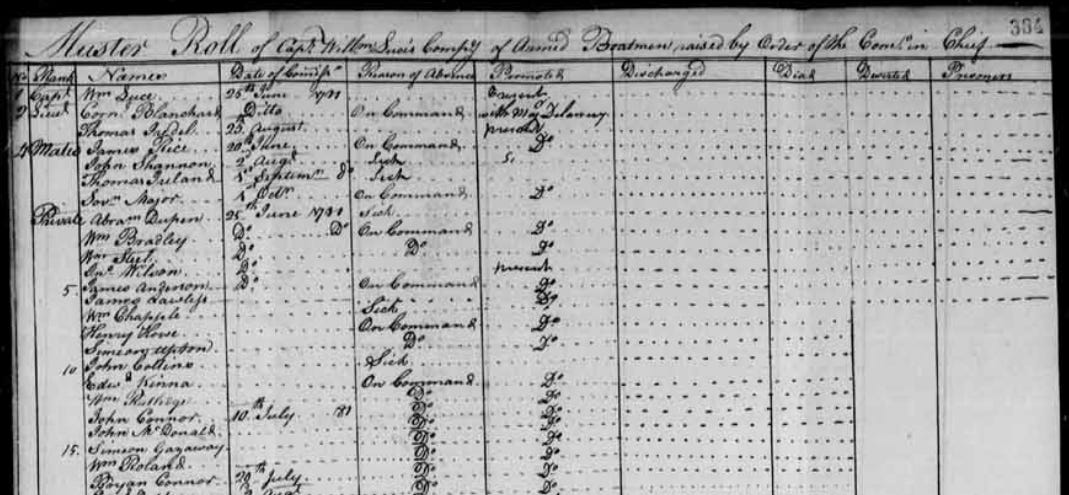
Muster Roll of Capt. Willm Luce’s Compy of Armed Boatmen, raised by Order of the Comdr in Chief. Wm Roland is line 16, On Command, present. https://www.bac-lac.gc.ca/eng/discover/military-heritage/loyalists/loyalists-ward-chipman/pages/image
William then mustered with the Armed Boatmen from at least Christmas Day 1781 until the end of 1782, including when the Company was under the command of Nathan Hubbill. That most likely puts him in these engagements:
Woodbridge, New Jersey, December 21, 1781
Elizabethtown Point, New Jersey, March 10, 1782
New Brunswick, New Jersey, January 8, 1782
Forked River, New Jersey, June 5, 1782
Toms River, New Jersey, March 23, 178214
At New Brunswick, the Armed Boatmen joined 200 to 300 troops to burn every boat on the Raritan River.15
Raid at Forked River
At Forked River, the saltworks were destroyed. Saltworks along the New Jersey shore were important targets, as they were a good source of income for the Patriots. Salt is not only necessary for life, but it was also vital to preserve meat for the winter. Before the Revolution, Americans imported salt from Britain. Starting in 1776, the British naval blockade caused a severe salt shortage. So American governments promoted domestic salt production. Many successful saltworks were located in the shallow bays along the Monmouth County shore. Pans filled with water at high tide; water was evaporated by boiling; sea salt was collected.16
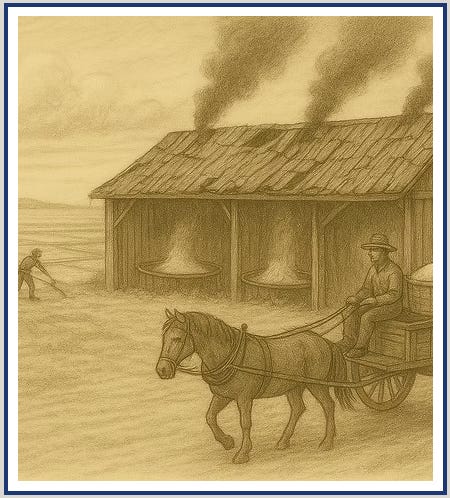
A sketch of saltworks in Monmouth County, New Jersey, during the Revolution17
On June 5, 1782, an article appeared in the New Jersey Gazette.
On the morning of the 1st, one Davenport, a refugee, landed with about 40 whites and 40 blacks, at Forked River, and burnt Samuel Brown's salt-works, and plundered him; they then proceeded southward toward Barnegat, for the purpose of burning the salt works along the shore between those places. Thus, they are conciliating the affections of the Americans!18
Davenport led a gang of homeless Loyalist refugees hiding out in the pine barrens at Refugeetown in Sandy Hook, New Jersey. Known as the Pine Robbers, they contained a large number of black Loyalists, who were escaped slaves and free blacks, mostly from the large African-American population in Monmouth County.19
The Gazette article blames Davenport while other sources credit the Armed Boatmen.19A
Raid at Toms River
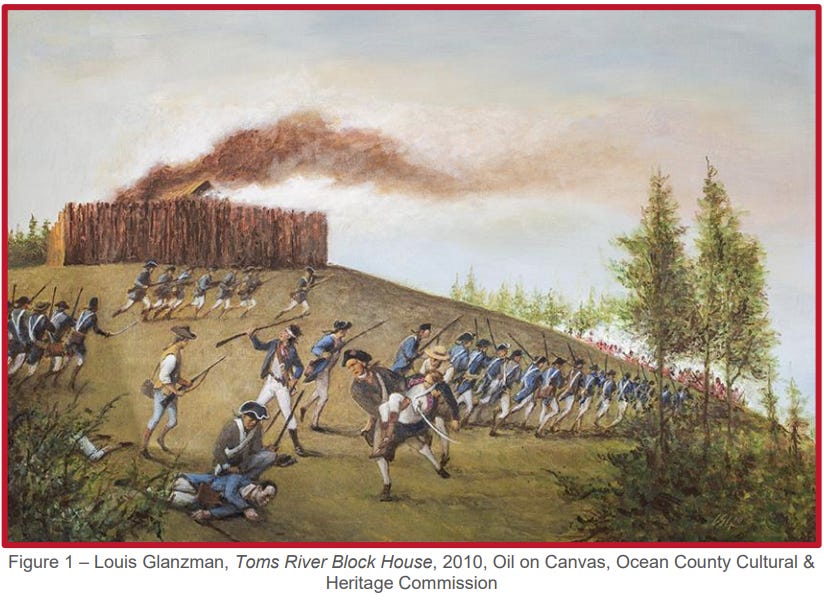
https://www.co.ocean.nj.us//WebContentFiles//3cb5f5a7-24d9-4d76-b0e3-373a2dbcc22b.pdf
The Toms River raid was probably the largest and most destructive one William fought in. Toms River was a coastal village of about 15 homes, 2 taverns, a mill, a few warehouses, a boatyard, and a blockhouse. The village sympathized solidly with the rebels and mainly supported itself by raiding the British. It was perfectly set up for such raiding. As the river was too shallow, ships had always anchored and sent cargo ashore in rowboats. At the time of the raid, about 20 small craft tied up at the wharf.
Toms River knew it was high on the list of revenge targets. Expecting the Loyalists to launch retaliatory raids, Toms River erected a blockhouse for defense. The blockhouse was basically a cage, constructed of heavy vertical logs six or seven feet high, with no doors, but loop holes between logs to shoot thru. Mounted on top were several brass cannons that swiveled. The only way for its 25 militiamen to get in or out was by ladder.
Around midnight on March 23, the British warship Arrogant led a force of about 120 Associated Loyalists and Armed Boatmen under Lieutenant Blanchard in whaleboats. They were spotted, but continued upriver under fire until they reached the blockhouse just before dawn. The militiamen inside had been alerted; ready on defense, they began shooting as the Loyalists approached. Boatman Lt. Blanchard called on the outnumbered militiamen to surrender, but they refused. The blockhouse was overrun. Lt. Iredell of the Boatmen was killed and about five Boatmen wounded.
The Loyalist forces burnt the blockhouse to the ground. Next they turned to the helpless town, plundering and burning every building except two houses, which they may have spared for personal reasons. Once the town was on fire and the people driven from their homes, they made their escape as smoothly as they had come. The Toms River fighters had stopped them from carrying out the rest of the raids planned for that day; instead, the Boatmen carried their wounded home.20
The Maryland Gazette reported:
The Refugees have paid Toms River a visit. They have burnt most of the houses, stripped and plundered the inhabitants of most everything. Mr. Daniel Randolph is (captured and) carried to New York. Moses Robins is badly wounded and stripped of everything. The inhabitants are in great distress.21
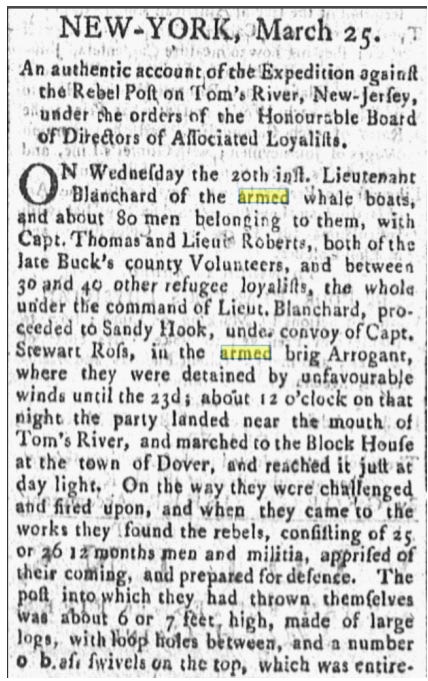
an account published in the New York Gazette, a Loyalist newspaper22
Great Whaleboat Battle
William was probably not involved in the Great Whaleboat Battle, but I include it here because it shows the ferocity on the part of his comrades-in-arms and his foes, ordinary men who had all been peaceable subjects of the King just a decade before. William’s muster rolls show him under the command of Lt. Blanchard, whereas this battle was between Lt. Johnson’s men in three boats against rebel Captain Caleb Brewster. It took place on the Sound outside Stamford, Connecticut on the 7th of December 1782.
American Major Benjamin Tallmadge described the battle in a letter to General George Washington. Rebel boats planned a raid on Long Island, but were stuck in Stamford several days by a squall of wind and heavy rain. They received word that three Loyalist boats were also sheltering nearby. When the Loyalists set out for Huntington, Long Island, Brewster pursued them; one boat sped away. “After a severe Conflict,” the rebels killed 6 and wounded and captured 10 men, including the entire crew of one boat. Brewster was severely wounded by a musket ball thru his body; several of his men were wounded but none killed.
Brewster wrote a detailed report during his recovery: He divided his six boats to surround the Loyalist boats, but only two of Brewster’s boats caught the Armed Boatmen. When Brewster sailed by Lt. Johnson’s boat, Johnson shot Brewster in the body and another man in the head, killing him. Brewster waited to fire until he was closer. The wind shifted and the men didn’t have time to reload, so they boarded the Loyalist boat using their musket butts as clubs. By the end of the battle, only one Loyalist was left unhurt. Five rebels were wounded, two with balls and the rest with bayonets. The Loyalists were well outfitted with three large wall pieces, by which I think he means cannons, and a complete set of King’s muskets with bayonets. One of the Mates, Hart, gave Brewster several blows with the cannon’s rammer. Lt. Johnson surrendered to the rebels after two of his men were killed by a swivel gun, which I also believe is a cannon. Brewster reported that “Seven of the Enemy are buried…two more lie…badly wounded the rest am informd are prisoners.” He went on to say he was “expecting to have another trial [with their boats shortly] as they infest this Coast daily.”
The Armed Boatmen’s next muster roll after this battle basically corroborates this account, reporting 5 men dead and 1 officer and 9 men captured.23
William disappeared off the Armed Boatmen’s muster rolls in 1783, the last year of the Revolution.24 He did not die, desert, surrender, serve somewhere else, or go to the hospital. Where was he?
Footnotes
Loyalists in the Maritimes - Ward Chipman Muster Master’s Office, 1777-1785. Muster roll Year: 1781 Volume: 27 Page(s): 370 Record Title: Muster Roll of Captain Nathan Hubbill’s Company of armed boatmen. Microfilm Reel Number: C-9818 Reference: MG 23 D1, Series 1 Item Number: 18188, Government of Canada Library and Archives of Canada
Kuhl, Jackson, Nov 1 2023, The Whaleboat Men of Long Island Sound, Journal of the American Revolution, https://allthingsliberty.com/2013/11/whale-boat-men-long-island-sound/, accessed 28 May 2026.
MacCallum, Kenneth, THE ARMED BOAT COMPANY AND THE GREAT WHALEBOAT BATTLE OF DECEMBER 7, 1782, pdf, https://uelac.ca/wp-content/uploads/2023/12/
https://en.wikipedia.org/wiki/Armed_Boat_Company
https://allthingsliberty.com/2013/11/whale-boat-men-long-island-sound/
The most famous New Jersey feud was that of Benjamin Franklin, an author of the Declaration of Independence, who supposedly encouraged his fellow congressmen to sign it by saying, “We must all hang together, or assuredly we will hang separately.” But Ben and his son William did not hang together. William Franklin had been the royal governor of New Jersey. Now displaced, he actively fought what his father so actively supported. https://www.battlefields.org/learn/biographies/william-franklin
https://en.wikipedia.org/wiki/Armed_Boat_Company
https://en.wikipedia.org/wiki/Armed_Boat_Company
https://royalprovincial.com/military/rhist/abc/abcform.htm
A. MacCallum
B. Armed Boat Company, Wikipedia
Muster Roll
https://en.wikipedia.org/wiki/De_Lancey%27s_Brigade
See my post on Jeremiah Rushton, Revolutionary War Cowboy, https://grandmasgrannysfamilyalbum.substack.com/p/revolutionary-war-cowboy
A. MacCallum
B. Armed Boat Company, Wikipedia
MacCallum
https://www.monmouthhistory.org/250/salt-works-begin.
https://www.monmouthhistory.org/250/salt-works-begin.
https://www.monmouthhistory.org/250/davenports-pine-robbers-routed-at-forked-river
https://www.monmouthhistory.org/250/davenports-pine-robbers-routed-at-forked-river
19A. I don't know if they worked together or what their connection was.
https://www.monmouthhistory.org/250/associated-loyalists-raze-toms-river
https://www.monmouthhistory.org/250/associated-loyalists-raze-toms-river
https://www.monmouthhistory.org/250/associated-loyalists-raze-toms-river
https://uelac.ca/wp-content/uploads/2023/12/Kenneth-MacCallum-Great-Whaleboat-Battle-1782.pdf
Muster Roll
MacCallumhttps://uelac.ca/wp-content/uploads/2023/12/Kenneth-MacCallum-Great-Whaleboat-Battle-1782.pdf
Comments
Post a Comment